How is the compressive resistance of 3003 hot-rolled aluminum round sheets for food containers?
In the field of food packaging and container manufacturing, “safety” and “durability” are always the core requirements. Aluminum food containers, in particular, face pressure tests of varying degrees at every stage—from production filling, warehouse stacking, and transportation to end-use. Static pressure during stacking, vibration and impact during transit, mechanical pressure during filling, and even pressure changes during high-temperature sterilization all impose stringent demands on the container’s pressure resistance. The 3003 hot-rolled aluminum disc, as a preferred base material for food container manufacturing, does not achieve this pressure resistance by accident. Instead, it is the result of the combined effects of material properties, processing technology, and structural design. Today, we will delve into the pressure resistance of 3003 hot-rolled aluminum disc food containers and discuss why it has become the “pressing-resistant specialist” in the food packaging industry.
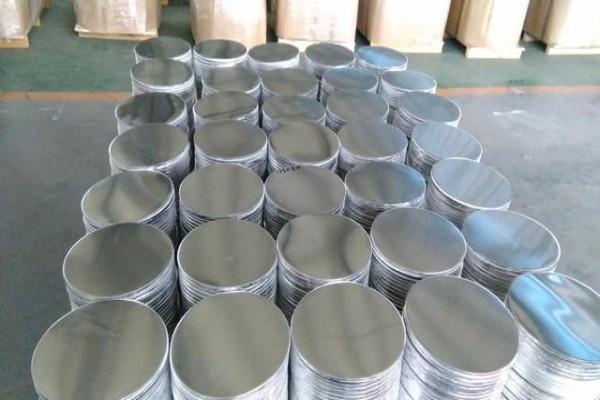 Extra thick hot-rolled aluminum sheets
I. The Core Material: 3003 Hot-Rolled Aluminum Disc, The Naturally Compatible Foundation for Pressure Resistance
To understand a container’s pressure resistance, we must start with the base material. 3003 aluminum alloy belongs to the aluminum-manganese series. With aluminum (97.0%–99.0%) as its base, it contains 1.0%–1.5% manganese (Mn) as the main alloying element, supplemented by small amounts of other trace elements like copper (Cu) and iron (Fe). This composition gives it a unique advantage in balancing strength and plasticity, laying the foundation for the container’s pressure resistance.
Compared to pure aluminum or other aluminum alloys, the core advantage of the 3003 hot-rolled aluminum disc lies in its “perfect balance of rigidity and flexibility”:
- Enhanced Strength and Hardness: The addition of manganese significantly improves the material’s strength and hardness. Its tensile strength can reach 210–250 MPa, and its yield strength ranges from 130–160 MPa, representing a 10%–20% increase compared to pure aluminum series like 1060. This effectively resists deformation and damage caused by external pressure.
- Superior Plasticity (Ductility): The elongation is typically ≥15%, and can even exceed 20%. This means the material can effectively disperse and absorb energy through plastic deformation under pressure, avoiding sudden brittle fracture.
- Excellent Workability and Stability: This alloy offers good formability and can be further hardened through cold working. It exhibits excellent corrosion resistance, remains stable in food-contact environments, and complies with domestic and international food safety standards.
These properties make 3003 hot-rolled aluminum discs the ideal choice for food containers ranging from beverage cans and food trays to pressure cooker components, achieving an excellent balance between strength, formability, and safety.
II. Key Factors Influencing Pressure Resistance
The pressure-resistant performance of a container made from 3003 hot-rolled aluminum discs is the combined result of process, design, and material. The key influencing factors are summarized below:
Table 1: Key Factors Affecting the Pressure Resistance of 3003 Hot-Rolled Aluminum Disc Containers
| Influencing Factor |
Specific Description |
Contribution to Pressure Resistance |
| 1. Base Material Process |
Compared to cast-rolling, hot-rolling produces a material with finer grains, more uniform microstructure, and fewer internal defects. Cast-rolling is more suitable for applications requiring extremely high deep-drawing performance with relatively lower pressure resistance demands. |
The hot-rolling process provides more uniform stress distribution and superior overall toughness, forming the fundamental guarantee for the pressure resistance of high-end containers. |
| 2. Thickness Specification |
Common thicknesses for food containers range from 0.5–4.5mm (e.g., beverage can body: 0.3-0.5mm, pressure cooker components: >1.0mm). |
Thickness is the core “hard indicator,” directly determining wall thickness and load-bearing capacity. It must be selected scientifically based on specific application (e.g., pressure level, content properties). |
| 3. Structural Design & Forming |
Designs like cylindrical can bodies, domed bottoms/lids optimize mechanical structure; precise drawing, seaming processes ensure structural integrity. |
Scientific design efficiently distributes pressure, avoiding local stress concentration; precision forming ensures uniform wall thickness, eliminating weak points. This is key to “design empowering material.” |
| 4. Material Temper |
Properties are primarily adjusted through cold-working hardening (e.g., H14, H18 tempers) and annealing (O temper). H tempers offer higher strength, O temper offers better ductility. |
Selecting the appropriate temper based on container forming difficulty and final-use strength requirements allows for optimized performance and cost configuration. |
In-Depth Analysis: The Synergistic Effect of Process and Design
- Deep Dive: Hot-Rolling vs. Cast-Rolling: The hot-rolling process is akin to “forging” the metal, breaking down the coarse as-cast structure. This not only eliminates defects like gas pores and shrinkage porosity but also allows for more uniform distribution of manganese. This uniform microstructure is the cornerstone of pressure resistance stability. In contrast, while cast-rolled material offers higher production efficiency and cost advantages, its rapid solidification results in a slightly less uniform microstructure, potentially leading to slightly greater performance fluctuation under extreme static or impact pressure.
- The “Amplifier” Effect of Structural Design: Material performance must be maximized through design. For example, the dome-shaped bottom of a beverage can is essentially a thin-shell structure under axial compression. It efficiently converts vertical pressure into circumferential stress in the can wall, achieving maximum compressive stiffness with minimal material. Similarly, reinforcing ribs and curled edges on the rims of rectangular food trays increase the cross-sectional moment of inertia through localized geometric changes, significantly enhancing bending and compression resistance. Excellent design allows the pressure-resistant potential of 3003 aluminum to be fully realized.
 Aluminum sheet manufacturing factory
III. Test Data: How Strong is the Pressure Resistance Really?
The industry validates pressure resistance through a series of standardized tests. Different test methods simulate different stress scenarios, with core data as follows:
Table 2: Typical Pressure Resistance Test Data and Application Standards for 3003 Hot-Rolled Aluminum Disc Food Containers
| Test Item |
Test Standard Reference |
Simulated Scenario & Test Method |
Typical Product Performance (Example) |
Performance Significance |
| Axial Load (Stacking) Test |
ISO 2234, GB/T 4857.3 |
Simulates multi-layer warehouse stacking. Applies vertical pressure to the top of the container until crushing or specified deformation is reached. |
A 330ml beverage can (body thickness ~0.28mm) can withstand an axial load of 1500–2500N, safely supporting 8-10 layers of stacking. |
Directly reflects the container’s vertical load-bearing capacity and storage stability. |
| Internal Pressure (Burst) Test |
ASTM D4577, GB/T 9106.1 |
Simulates internal pressure from carbonated beverages or high-temperature sterilization. Pressurizes a sealed container until rupture. |
Carbonated beverage cans typically require an internal pressure resistance of ≥0.9 MPa; pressure cooker aluminum inner pots require a burst pressure of ≥600 kPa. |
Ensures the container does not explode under internal pressure, guaranteeing safety. |
| Side Wall Compression Test |
GB/T 18454 |
Simulates lateral crushing during transportation. Applies pressure to the can body side to evaluate dent resistance. |
A qualified beverage can’s sidewall deformation under specified pressure must be below the standard limit, preventing mutual deformation inside cases. |
Reflects the container’s resistance to crushing and impact during transport and on-shelf display. |
| Cycle Pressure / Drop Test |
ASTM D5276, GB/T 4857.5 |
Simulates repeated impacts from handling and loading/unloading. Involves multiple drops or pressure cycles. |
After completing the specified number of drops or pressure cycles, the container must not leak or suffer structural damage. |
Evaluates the container’s fatigue resistance and long-term durability. |
Note: Specific test data varies based on container design, thickness, and process. The table above shows common industry ranges. Manufacturers must conduct precise testing according to specific product standards.
The Science Behind the Testing:
In axial load tests, the container’s failure mode is often buckling instability rather than the material being crushed. This highlights the characteristics of thin-walled structures and underscores the decisive influence of structural design (e.g., bottom shape, can height-to-diameter ratio) on pressure resistance results. Internal pressure tests primarily challenge the material’s intrinsic strength and the integrity of welds/seams. Scientific testing not only provides a pass/fail judgment but also, through analysis of failure points and load-deformation curves, offers direct data support for optimizing materials and design.
IV. Full-Lifecycle Application: How Pressure Resistance Safeguards Food Safety
The pressure resistance of 3003 hot-rolled aluminum disc containers translates into tangible safety and economic benefits across various application stages:
1. Production and Filling Stage:
On high-speed filling lines, containers must withstand mechanical pressure from filling heads and pressure changes from vacuuming or nitrogen flushing. Superior pressure resistance ensures containers do not deform or jam on the line, guaranteeing a smooth, tight seal, providing the initial barrier for the contents.
2. Warehousing and Logistics Stage:
This is one of the biggest challenges for pressure resistance. Modern warehousing uses high racks with multiple stacking layers, imposing significant static load on bottom containers. During logistics, vibrations, bumps, and random impacts create complex dynamic forces. 3003 aluminum containers, with their strength and toughness, effectively resist static stacking pressure and buffer dynamic impacts through elastic deformation, significantly reducing transportation damage rates and minimizing product loss and food safety risks.
3. End-Use and Storage Stage:
- Retail: On shelves, containers need to withstand挤压 from other products and handling impacts from consumers.
- Household: Containers face multi-layer storage in refrigerators, repeated opening/closing, and potential accidental drops, all requiring good local抗压 and impact resistance.
- Special Processing: For foods requiring high-temperature retort sterilization (e.g., canned luncheon meat) or refrigeration/freezing, containers must withstand the pressure differential caused by drastic temperature changes. The stable thermal expansion coefficient and good low-temperature toughness of 3003 aluminum alloy ensure its reliability across a wide temperature range.
 Aluminum round pieces for kitchenware
4. Challenges in Emerging Applications:
With the rise of prepared meals, self-heating foods, and premium pet food, new pressure resistance demands are placed on packaging. For example, self-heating packs generate steam pressure, requiring containers to maintain structural integrity for a specified time; the texture requirements for pet food may demand containers that can withstand more complex physical impacts. 3003 hot-rolled aluminum discs, through adjusted thickness, optimized coatings, and structural design, are continuously adapting to these new requirements.
V. Conclusion: The “Optimal Solution” for Pressure Resistance and Safety, and Future Outlook
The application of 3003 hot-rolled aluminum discs in food containers embodies a comprehensive balance of strength, plasticity, economy, and safety. Its pressure-resistant advantages stem from the deep integration of materials science, process assurance, and design intelligence:
- The Foundation – Material: Solid solution strengthening from the Al-Mn alloy and grain refinement strengthening from the hot-rolling process provide a uniform, strong, and tough base.
- The Precision – Process: Accurate thickness control, forming technology, and appropriate temper state translate material potential into product performance.
- The Ingenuity – Design: Structural designs like cylinders, domes, and reinforcing ribs achieve maximum structural stiffness with minimal weight.
From ubiquitous beverage cans to demanding pressure cookers, 3003 hot-rolled aluminum discs, with their reliable pressure-resistant performance, safeguard food safety and quality throughout the entire packaging lifecycle. As the industry’s demands for lightweighting, sustainability, and intelligence increase, research into the pressure resistance of 3003 aluminum alloy and its products will continue to deepen.
Future Trends and Recommendations
- For Manufacturers: Beyond optimizing thickness and forming processes, actively explore combinations with coating technologies (e.g., strengthening inner coatings) and utilize digital tools like Finite Element Analysis (FEA) to optimize container structure in virtual environments, enabling accurate prediction and enhancement of pressure resistance.
- For Industry Professionals: Develop a more systematic understanding—pressure resistance is a systematic engineering project involving “material grade selection → process path determination → structural design implementation → rigorous test validation.” A deep understanding of the interaction between each is key to scientific material selection and quality control.
- Industry Trend Outlook: In the context of the circular economy, the excellent recyclability of 3003 aluminum alloy is as important as its pressure resistance. In the future, 3003-series alloys using a higher proportion of recycled aluminum (while still meeting performance standards) will become an important development direction, reducing the carbon footprint while maintaining pressure resistance. Simultaneously, the co-design of pressure resistance and lightweighting for personalized, small-batch food packaging will also be a hotspot for technological innovation.
Properties of the aluminum circle:
Aluminum circle is suitable for many markets, including cookware, automotive and lighting industries, etc., thanks to good product characteristics:
- Low anisotropy, which facilitates deep drawing
- Strong mechanical properties
- High and homogeneous heat diffusion
- Ability to be enameled, covered by PTFE (or others), anodized
- Good reflectivity
- High strength-to-weight ratio
- Durability and resistance to corrosion
Aluminum Circles Process
Ingot/Master Alloys — Melting Furnace – Holding Furnace — D.C. Caster — Slab —- Scalper — Hot Rolling Mill – Cold Rolling Mill – Punching – Annealing Furnace — Final Inspection – Packing — Delivery
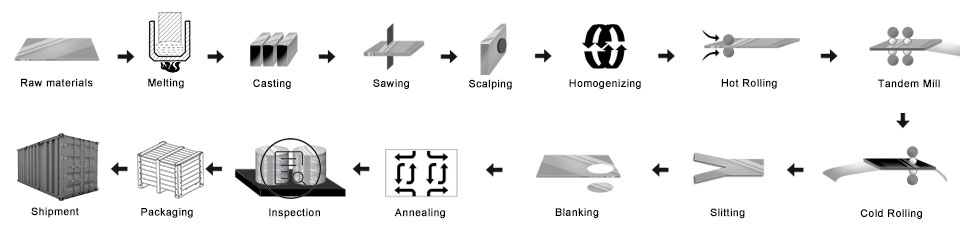
- Prepare the master alloys
- Melting furnace: put the alloys into the melting furnace
- D.C.cast aluminum ingot: To make the mother ingot
- Mill the aluminum ingot: to make the surface and side smooth
- Heating furnace
- Hot rolling mill: made the mother coil
- Colding rolling mill: the mother coil was rolled as the thickness you want to buy
- Punching process: become the size what you want
- Annealing furnace: change the temper
- Final inspection
- Packing: wooden case or wooden pallet
- Delivery
Quality Control
Assurance Below inspection will be done in the production.
- a. ray detection—RT;
- b. ultrasonic testing—UT;
- c. Magnetic Particle Testing-MT;
- d. penetration testing-PT;
- e. eddy current flaw detection-ET
1) Be free from Oil Stain, Dent, Inclusion, Scratches, Stain, Oxide Discoloration, Breaks, Corrosion, Roll Marks, Dirt Streaks, and other defects which will interfere with use.
2) Surface without black line, clean-cut, periodic stain, roller printing defects, such as other gko internal Control standards.
Aluminum discs packing:
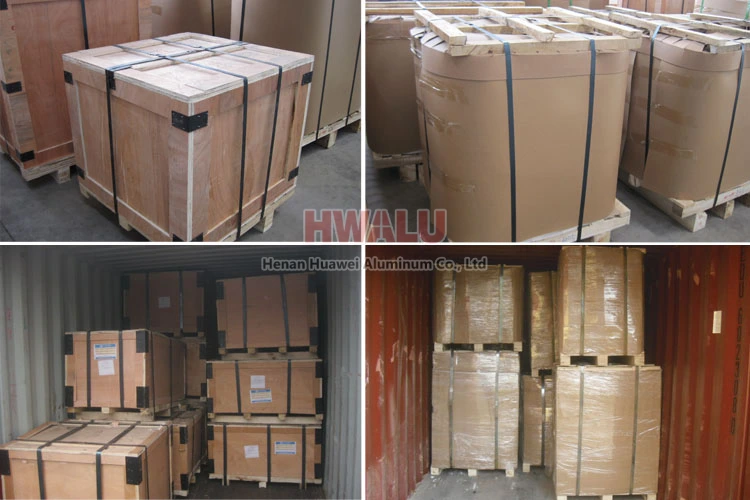
Aluminum circles can be packed by export standards, covering with brown paper and plastic film. Finally, the Aluminium Round is fixed on a wooden pallet/wooden case.
- Put the driers side the aluminum circle, keep the products dry and clean.
- Use clean plastic paper, pack the aluminium circle, keep good sealing.
- Use the snakeskin paper, pack the surface of the plastic paper, keep good sealing.
- Next, there are two ways of packaging: One way is wooden pallet packaging, using the crusty paper packing the surface; Another way is wooden case packaging, using the wooden case packing the surface.
- Finally, lay the steel belt on the wooden box’s surface, keeping the wooden box fastness and secure.
Aluminum circle of Henan Huawei Aluminum. meet the export standard. Plastic film and brown paper can be covered at customers’ needs. What’s more, a wooden case or wooden pallet is adopted to protect products from damage during delivery. There are two kinds of packaging, which are eye to wall or eye to the sky. Customers can choose either of them for their convenience. Generally speaking, there are 2 tons in one package, and loading 18-22 tons in 1×20′ container, and 20-24 tons in 1×40′ container.
Why choose us?
In order to move with the times, HWALU keeps introducing the state of the art equipment and technique to improve its competitiveness. Always adhere to the business philosophy of quality as the center and customer first, to provide the highest quality aluminum disc circle series products to all parts of the world. More …

