Aluminum Disc Edge Quality Control in Modern Manufacturing
Introduction
Effective aluminum disc edge quality control is fundamental to ensuring the performance, forming stability, and end-use safety of cookware, lighting components, and pressure-bearing industrial parts. As production speeds increase and thickness tolerances tighten, manufacturers must adopt a systematic approach to edge inspection, trimming, and defect management. This article provides a technical overview of edge-related variations, their sources, and the quality assurance tools used across the global aluminum flat-rolled industry.

1. Key Edge Defects in Aluminum Disc Production
Edge quality issues commonly arise during blanking, slitting, or trimming. These defects influence downstream forming, particularly deep drawing and spinning.
Table 1. Common Edge Defects and Engineering Impact
| Edge Defect Type |
Physical Characteristics |
Typical Root Cause |
Impact on Forming |
Severity Level |
| Burrs / Rough Edges |
Sharp, raised metal on the rim |
Dull tools, misalignment, inadequate lubrication |
Causes die scratches, tearing during deep drawing |
High |
| Edge Waviness |
Non-uniform ripples along the edge |
Uneven blank holder force, coil residual stress |
Poor spinning uniformity and thickness variation |
Medium–High |
| Micro-Cracks |
Tiny fissures near the periphery |
Over-hard temper, excessive shear force |
Crack propagation during forming |
Very High |
| Edge Roll-Over |
Rounded, folded edge geometry |
Incorrect punch-die clearance |
Reduced dimensional accuracy |
Medium |
| Surface Lamination at Edge |
Peeling layers or delamination |
Ingot impurity or casting defects |
Weakens structural integrity |
High |
2. Process Variables Affecting Edge Stability
Edge integrity is influenced by upstream metallurgy and downstream mechanical cutting parameters. Metallurgical conditions—grain size, temper, and lubricity—determine the metal’s response to shear deformation.
Table 2. Metallurgical & Process Variables Affecting Edge Quality
| Variable |
Target Specification |
Effect on Edge Stability |
Control Method |
| Alloy & Temper (1050/1060/3003) |
Fully annealed O-temper preferred |
Higher ductility reduces micro-crack formation |
Continuous annealing furnace control |
| Grain Size |
ASTM 5–8 |
Smaller grains improve shear strength |
Homogenization & rolling schedule optimization |
| Punch–Die Clearance |
6–10% of sheet thickness |
Too small → burrs; too large → roll-over |
CNC die set calibration |
| Tool Hardness |
HRC 58–62 |
Ensures long-term consistency |
Vacuum heat treatment |
| Lubrication Quality |
Clean, stable viscosity oils |
Reduces shear heat & defects |
Automated spray lubrication |

3. Advanced Edge Quality Control Methods
Modern factories apply a combination of mechanical inspection, optical measurement, and statistical tracking.
Commonly Applied Inspection Technologies
- High-resolution edge cameras to detect waviness <0.05 mm
- Laser micrometers for circumferential dimensional stability
- Automated burr sensors measuring height at 360°
- Eddy-current crack detection for micro-fracture identification
- Shear-force monitoring integrated into stamping presses
These tools strengthen aluminum disc edge quality control systems, enabling predictive maintenance and reducing scrap.
4. Comparison of Edge-Trimming Technologies
Different factories use various trimming systems depending on production scale and forming requirements.
Table 3. Comparison of Trimming Methods Used in Aluminum Disc Finishing
| Parameter |
Mechanical Trimming |
CNC Rotary Trimming |
Laser-Assisted Trimming |
| Precision Level |
±0.15 mm |
±0.05 mm |
±0.03 mm |
| Edge Burr Height |
30–60 μm |
10–20 μm |
<5 μm |
| Suitable Thickness |
0.5–4.0 mm |
0.8–6.0 mm |
0.3–3.0 mm |
| Production Speed |
High |
Medium |
Low–Medium |
| Equipment Cost |
Low |
Medium |
High |
| Ideal Application |
Cookware, general parts |
High-end cookware, lighting |
Precision industrial discs |

5. Best Practices for Edge Quality Assurance
To maintain high discipline in aluminum disc edge quality control, factories typically follow these engineering procedures:
Process Best Practices
- Use annealed tempers for deep drawing to avoid micro-cracks.
- Optimize punch–die clearance according to exact thickness.
- Implement 100% visual inspection for high-end cookware or pressure components.
- Adopt SPC (Statistical Process Control) for burr height and roundness deviation.
- Perform regular tool regrinding every 50,000–100,000 strokes.
- Use deburring machines with controlled abrasive grain size for uniform results.
Quality Thresholds Recommended by Industry
- Burr height: <20 μm for spinning-grade discs
- Edge waviness: <0.10 mm
- Crack tolerance: Zero cracks allowed under 10× magnification
- Roundness deviation: <0.20 mm for cookware-grade discs
These thresholds reflect global best practices from cookware and automotive stamping supply chains.

Conclusion
Consistent aluminum disc edge quality control directly determines the forming performance, safety, and surface stability of finished products. With more manufacturers transitioning to automated trimming and optical inspection, the industry is moving toward digitized, repeatable, and high-precision edge management. By integrating metallurgical optimization, advanced trimming technologies, and strict SPC monitoring, factories can significantly enhance product competitiveness and reduce overall manufacturing risk.
Properties of the aluminum circle:
Aluminum circle is suitable for many markets, including cookware, automotive and lighting industries, etc., thanks to good product characteristics:
- Low anisotropy, which facilitates deep drawing
- Strong mechanical properties
- High and homogeneous heat diffusion
- Ability to be enameled, covered by PTFE (or others), anodized
- Good reflectivity
- High strength-to-weight ratio
- Durability and resistance to corrosion
Aluminum Circles Process
Ingot/Master Alloys — Melting Furnace – Holding Furnace — D.C. Caster — Slab —- Scalper — Hot Rolling Mill – Cold Rolling Mill – Punching – Annealing Furnace — Final Inspection – Packing — Delivery
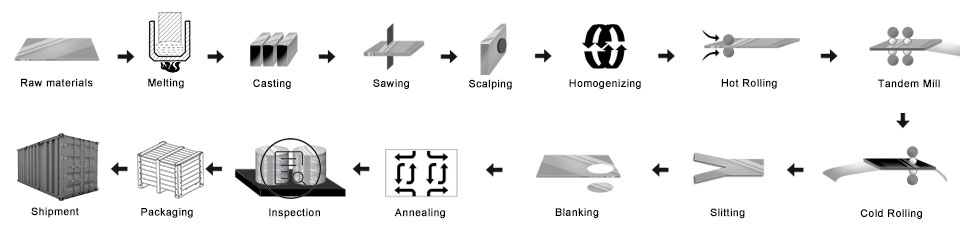
- Prepare the master alloys
- Melting furnace: put the alloys into the melting furnace
- D.C.cast aluminum ingot: To make the mother ingot
- Mill the aluminum ingot: to make the surface and side smooth
- Heating furnace
- Hot rolling mill: made the mother coil
- Colding rolling mill: the mother coil was rolled as the thickness you want to buy
- Punching process: become the size what you want
- Annealing furnace: change the temper
- Final inspection
- Packing: wooden case or wooden pallet
- Delivery
Quality Control
Assurance Below inspection will be done in the production.
- a. ray detection—RT;
- b. ultrasonic testing—UT;
- c. Magnetic Particle Testing-MT;
- d. penetration testing-PT;
- e. eddy current flaw detection-ET
1) Be free from Oil Stain, Dent, Inclusion, Scratches, Stain, Oxide Discoloration, Breaks, Corrosion, Roll Marks, Dirt Streaks, and other defects which will interfere with use.
2) Surface without black line, clean-cut, periodic stain, roller printing defects, such as other gko internal Control standards.
Aluminum discs packing:
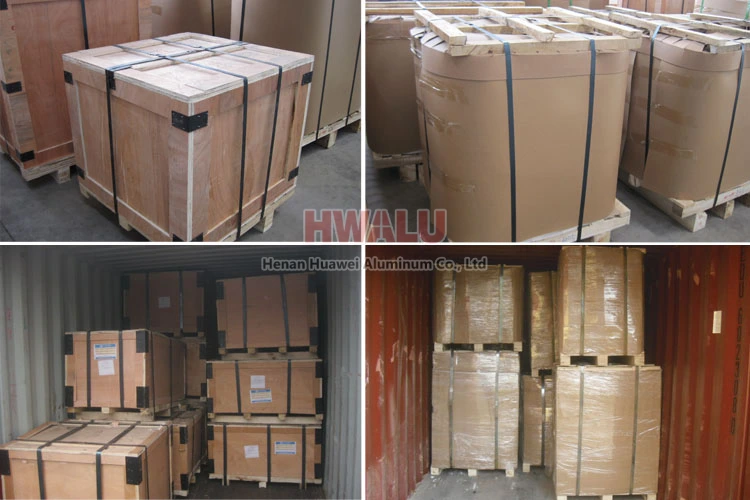
Aluminum circles can be packed by export standards, covering with brown paper and plastic film. Finally, the Aluminium Round is fixed on a wooden pallet/wooden case.
- Put the driers side the aluminum circle, keep the products dry and clean.
- Use clean plastic paper, pack the aluminium circle, keep good sealing.
- Use the snakeskin paper, pack the surface of the plastic paper, keep good sealing.
- Next, there are two ways of packaging: One way is wooden pallet packaging, using the crusty paper packing the surface; Another way is wooden case packaging, using the wooden case packing the surface.
- Finally, lay the steel belt on the wooden box’s surface, keeping the wooden box fastness and secure.
Aluminum circle of Henan Huawei Aluminum. meet the export standard. Plastic film and brown paper can be covered at customers’ needs. What’s more, a wooden case or wooden pallet is adopted to protect products from damage during delivery. There are two kinds of packaging, which are eye to wall or eye to the sky. Customers can choose either of them for their convenience. Generally speaking, there are 2 tons in one package, and loading 18-22 tons in 1×20′ container, and 20-24 tons in 1×40′ container.
Why choose us?
In order to move with the times, HWALU keeps introducing the state of the art equipment and technique to improve its competitiveness. Always adhere to the business philosophy of quality as the center and customer first, to provide the highest quality aluminum disc circle series products to all parts of the world. More …