Why Surface Flatness Matters When Buying Aluminum Discs for Spinning
The aluminum disc surface flatness requirement is one of the most critical parameters manufacturers must evaluate when sourcing discs for metal spinning, cookware forming, and precision deep-drawing applications. Because spinning is a process that depends on controlled deformation, consistent geometry, and predictable metal flow, even slight deviations in aluminum disc surface flatness can lead to wrinkles, uneven wall thickness, vibration marks, or catastrophic forming failures.
 The aluminum round pieces being packed
The Technical Meaning of Surface Flatness in Aluminum Discs
Surface flatness refers to the degree to which an aluminum disc maintains a uniform plane across its diameter before forming. In spinning, tools rotate at high speed while the disc undergoes radial stretching. Any wave, buckling, or camber on the starting disc multiplies during shaping.
Key engineering implications include:
- Material flow uniformity: flat discs deform in a predictable radial pattern.
- Dimensional stability: ensures consistent height and diameter of finished cookware or components.
- Stress distribution: minimizes localized stress peaks that lead to tearing.
- Tooling efficiency: reduces die wear and prevents vibration damage to spinning rollers.
Why Flatness Issues Cause Spinning Defects
A practical example is seen in commercial fry-pan manufacturing. A 3–6 mm deflection on a 400 mm aluminum disc might seem insignificant, but during spinning, this deflection rotates at several thousand RPM. Once pressed against the spinning mandrel, the high-speed asymmetric contact generates a ripple effect which directly causes:
- “Ear” deformation on rim edges
- Wrinkles near the shoulder transitions
- Wall thinning beyond tolerance limits
- Increased scrap rate and unbalanced cookware bottoms
This is why top cookware brands maintain strict acceptance standards for the incoming disc geometry.
Case Study: How Henan Huawei Aluminum Co., Ltd Solved a Spinning Defect Problem
A European cookware manufacturer approached Henan Huawei Aluminum Co., Ltd after facing a persistent 7–8% defect rate in spinning 1050 and 3003 discs sourced from another supplier. Their primary issue: non-uniform disc flatness causing ripples and bottom warping.
Huawei Aluminum’s solution included:
- Upgrading to hot-rolled feedstock to improve microstructure uniformity.
- Introducing a precision leveling process (six-roller tension leveling).
- Implementing a disc flatness QC window of ≤0.3% of disc diameter.
- 100% mechanical surface scanning during final inspection.
Result for the customer:
| Indicator |
Before Huawei |
After Huawei |
| Scrap Rate |
7–8% |
<1.2% |
| Spinning Time per Piece |
42–46 sec |
36–38 sec |
| Rim Uniformity |
±0.9 mm |
±0.3 mm |
| Bottom Warping Complaints |
Frequent |
Eliminated |
The case demonstrates how aluminum disc surface flatness directly impacts spinning performance and overall production stability.
 Production of aluminum round pieces has been completed.
How to Evaluate Aluminum Disc Surface Flatness Before Purchasing
Manufacturers should adopt a structured QC approach:
1. Flatness Tolerance (Critical Standard)
General spinning-grade tolerances depend on disc diameter and alloy:
| Disc Diameter (mm) |
Recommended Flatness Tolerance |
Process Level |
| ≤ 300 mm |
≤ 0.25% of diameter |
Standard cookware |
| 300–450 mm |
≤ 0.30% of diameter |
Large pans / basins |
| ≥ 450 mm |
≤ 0.35% of diameter |
Deep spinning / industrial |
For example:
A 400 mm disc should not exceed 1.2 mm of flatness deviation.
2. Measuring Methods
- Precision straight-edge gap measurement
- Laser flatness scanner (Huawei uses this for high-volume orders)
- Three-point dial gauge fixtures
- Surface tension leveling inspection reports
Differences in Flatness Performance Across Production Routes
Flatness is heavily influenced by upstream processing.
Table: Hot-Rolled vs. Cold-Rolled vs. Cast-Rolled Disc Material
| Property |
Hot-Rolled Aluminum Discs |
Cold-Rolled Aluminum Discs |
Cast-Rolled Aluminum Discs |
| Flatness Stability |
★★★★★ Excellent |
★★★★ Good |
★★ Fair |
| Spinning Reliability |
Very high |
High |
Medium |
| Surface Stress Distribution |
Uniform |
Medium uniformity |
Poor uniformity |
| Usage |
Premium cookware / deep spinning |
Mainstream cookware |
Low-cost products |
| Best For |
Heavy spinning, thicker pans |
Frying pans, lids |
Disposable or low-load parts |
This table shows why premium spinning manufacturers prefer hot-rolled feedstock.
 Details of the aluminum sheet
Practical Example: Defect Analysis in Real Spinning Production
A factory producing 330 mm deep salad bowls recorded repeating defects:
- Circumferential wrinkles at 30–40° from the center
- Random bottom vibration marks
- Inconsistent wall thickness at shoulder transition
After investigation, engineers identified flatness deviations averaging 1.8 mm on incoming discs. Switching to controlled-flatness discs reduced the defects dramatically:
- Wrinkle rate: down 83%
- Shoulder wall variation: down 55%
- Bowl symmetry: significantly improved
How Henan Huawei Aluminum Co., Ltd Ensures Flatness Stability
Huawei’s spinning-grade discs meet international cookware and spinning standards because they strictly control:
- Hot-rolling precision for stable grain structure
- Automated tension-leveling
- Online width & camber correction
- Optical flatness measurement
- Batch-specific deformation simulation tests
Their aluminum disc surface flatness QC process is widely recognized among European, Southeast Asian, and Middle Eastern cookware manufacturers.
FAQ: Common Questions About Aluminum Disc Surface Flatness
1. What flatness tolerance is required for deep spinning?
For deep spinning (>80 mm height ratio), tolerance should be ≤0.25–0.30% of disc diameter.
2. Does alloy type affect flatness?
Yes. 3003, 3004, and 3105 usually maintain better flatness after annealing compared with 1050 or 1100.
3. Why does flatness matter more than thickness accuracy for spinning?
Thickness affects strength, but flatness affects dynamic deformation geometry, which is more sensitive in spinning.
4. Are cast-rolled discs suitable for cookware spinning?
Not for mid-to-high-end cookware. Cast-rolled discs often fail spinning tests due to poor flatness uniformity.
5. Can flatness problems be corrected in-house?
Limited correction is possible through mechanical leveling, but severe flatness issues cannot be fully corrected without degrading mechanical properties.
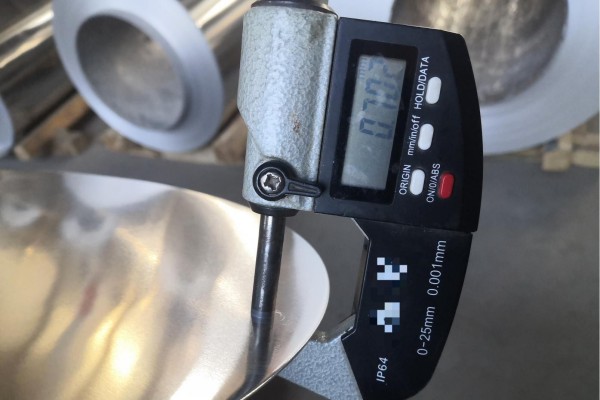 The thickness of the aluminum sheet is being measured.
Conclusion
Every experienced spinning manufacturer understands that aluminum disc surface flatness is not a minor detail but a foundational guarantee of forming quality, dimensional accuracy, and production efficiency. With the increasing demand for premium cookware and high-precision spinning components, controlling disc geometry has become essential.
Suppliers like Henan Huawei Aluminum Co., Ltd demonstrate that when flatness standards are strictly controlled, productivity rises, scrap falls, and the final product meets world-class performance expectations.
Properties of the aluminum circle:
Aluminum circle is suitable for many markets, including cookware, automotive and lighting industries, etc., thanks to good product characteristics:
- Low anisotropy, which facilitates deep drawing
- Strong mechanical properties
- High and homogeneous heat diffusion
- Ability to be enameled, covered by PTFE (or others), anodized
- Good reflectivity
- High strength-to-weight ratio
- Durability and resistance to corrosion
Aluminum Circles Process
Ingot/Master Alloys — Melting Furnace – Holding Furnace — D.C. Caster — Slab —- Scalper — Hot Rolling Mill – Cold Rolling Mill – Punching – Annealing Furnace — Final Inspection – Packing — Delivery
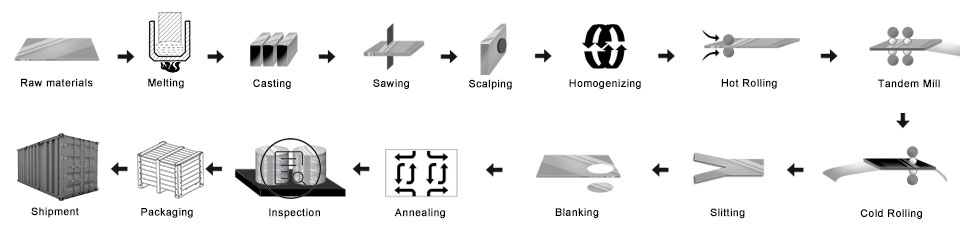
- Prepare the master alloys
- Melting furnace: put the alloys into the melting furnace
- D.C.cast aluminum ingot: To make the mother ingot
- Mill the aluminum ingot: to make the surface and side smooth
- Heating furnace
- Hot rolling mill: made the mother coil
- Colding rolling mill: the mother coil was rolled as the thickness you want to buy
- Punching process: become the size what you want
- Annealing furnace: change the temper
- Final inspection
- Packing: wooden case or wooden pallet
- Delivery
Quality Control
Assurance Below inspection will be done in the production.
- a. ray detection—RT;
- b. ultrasonic testing—UT;
- c. Magnetic Particle Testing-MT;
- d. penetration testing-PT;
- e. eddy current flaw detection-ET
1) Be free from Oil Stain, Dent, Inclusion, Scratches, Stain, Oxide Discoloration, Breaks, Corrosion, Roll Marks, Dirt Streaks, and other defects which will interfere with use.
2) Surface without black line, clean-cut, periodic stain, roller printing defects, such as other gko internal Control standards.
Aluminum discs packing:
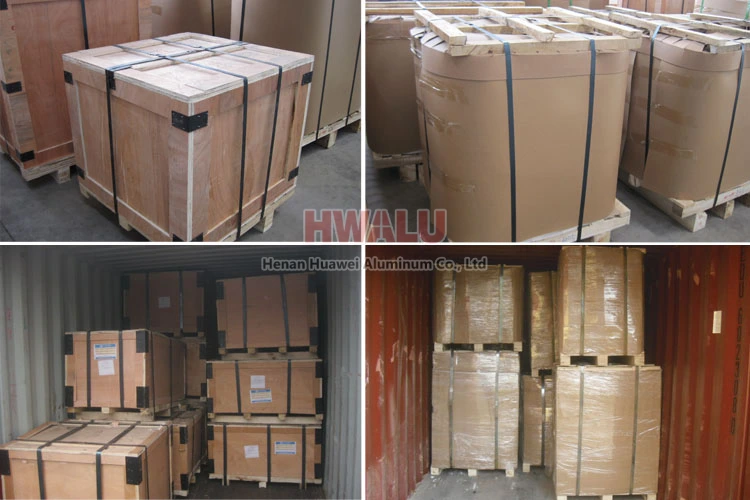
Aluminum circles can be packed by export standards, covering with brown paper and plastic film. Finally, the Aluminium Round is fixed on a wooden pallet/wooden case.
- Put the driers side the aluminum circle, keep the products dry and clean.
- Use clean plastic paper, pack the aluminium circle, keep good sealing.
- Use the snakeskin paper, pack the surface of the plastic paper, keep good sealing.
- Next, there are two ways of packaging: One way is wooden pallet packaging, using the crusty paper packing the surface; Another way is wooden case packaging, using the wooden case packing the surface.
- Finally, lay the steel belt on the wooden box’s surface, keeping the wooden box fastness and secure.
Aluminum circle of Henan Huawei Aluminum. meet the export standard. Plastic film and brown paper can be covered at customers’ needs. What’s more, a wooden case or wooden pallet is adopted to protect products from damage during delivery. There are two kinds of packaging, which are eye to wall or eye to the sky. Customers can choose either of them for their convenience. Generally speaking, there are 2 tons in one package, and loading 18-22 tons in 1×20′ container, and 20-24 tons in 1×40′ container.
Why choose us?
In order to move with the times, HWALU keeps introducing the state of the art equipment and technique to improve its competitiveness. Always adhere to the business philosophy of quality as the center and customer first, to provide the highest quality aluminum disc circle series products to all parts of the world. More …

