Aluminum discs from Lagos kitchenware manufacturers, with high-quality grade and reasonable price information
1. Introduction: Growing Demand for High-Quality Aluminum Circles in Lagos Cookware Manufacturing
Aluminum Circles for Lagos Cookware Manufacturers are gaining increasing strategic importance within the global aluminum supply chain. With the ongoing upgrade of Nigeria’s manufacturing sector, the acceleration of industrial localization, and rising expectations for product quality, cost control, and production efficiency, aluminum circles have become a critical raw material for cookware production. Their alloy grade, thickness tolerance, surface quality, formability, and price competitiveness now play a decisive role in procurement decisions.
This article provides a comprehensive and professional analysis of the role of aluminum circles in cookware manufacturing, suitable alloy grades, technical specifications, procurement strategies, real-world case studies, comparative evaluations, and frequently asked questions. It is designed as a high-value, search-engine-friendly reference for cookware manufacturers, purchasing managers, and supply chain decision-makers in Lagos and surrounding regions.
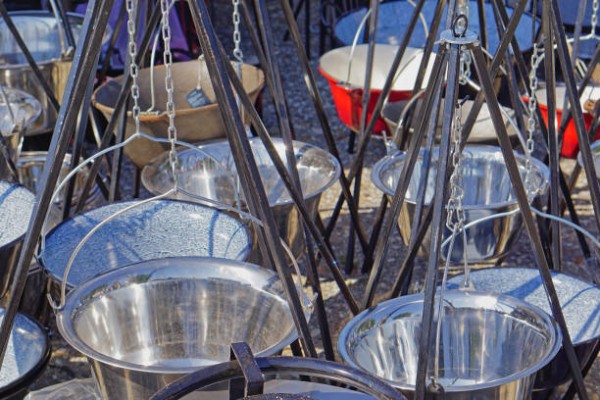 Aluminum pots are on sale.
2. The Role and Value of Aluminum Circles in Cookware Manufacturing
2.1 What Are Aluminum Circles
Aluminum circles are circular blanks produced from aluminum sheets or coils through cutting, stamping, annealing, and precision edge finishing. They are widely used as base materials for cookware bottoms, lids, and preforms for deep-drawn cookware bodies.
2.2 Core Value of Aluminum Circles in Cookware Production
| Value Dimension |
Description |
| Material consistency |
Precise thickness and alloy control ensure product uniformity |
| Formability |
Easy deep drawing with reduced cracking risk |
| Finished product quality |
Directly affects durability and surface appearance |
| Cost control |
Raw material pricing and scrap rate impact total manufacturing cost |
As the “source material” of cookware manufacturing, aluminum circles directly determine production yield, cycle time, and cost efficiency.
3. Market Background of Cookware Manufacturing in Lagos
Lagos is one of the most important manufacturing hubs in Nigeria and West Africa. Its cookware industry continues to expand across household cookware, tableware, and commercial kitchen equipment. As consumer demand shifts toward safe, durable, and lightweight cookware, local manufacturers are increasingly prioritizing high-performance aluminum circles with stable and predictable quality.
 The city of Lagos
4. Main Aluminum Alloy Grades Used for Cookware Circles
Different aluminum alloys offer distinct performance characteristics. In cookware manufacturing, the most commonly used alloys include the following:
4.1 Alloy Performance Comparison Table
| Alloy |
Main Elements |
Formability |
Thermal Conductivity |
Cost Level |
Typical Applications |
| 1050 |
≥99.5% Al |
Excellent |
High |
Low |
Light household cookware bottoms |
| 1070 |
≥99.7% Al |
Excellent |
Very high |
Medium |
High-heat-conductivity cookware bases |
| 3003 |
Al–Mn |
Good |
Good |
Medium |
Commercial cookware bodies |
| 5052 |
Al–Mg |
Good |
Medium |
Medium–High |
Corrosion-resistant cookware |
Each alloy has its own advantages, and manufacturers should select materials based on product positioning and performance requirements.
5. Key Technical Specifications of Aluminum Circles
When sourcing aluminum circles for cookware manufacturing in Lagos, the following technical parameters are critical:
5.1 Technical Specification Table
| Parameter |
Typical Requirement |
Description |
| Chemical composition |
ASTM / GB / EN compliant |
Determines mechanical and corrosion performance |
| Thickness tolerance |
±0.02 mm to ±0.05 mm |
Controls deformation during deep drawing |
| Surface quality |
Free from scratches, oxide scale, dents |
Ensures visual quality and smooth processing |
| Temper |
O / H14 / H16 optional |
Determines softness and formability |
| Flatness |
≤0.5 mm / 300 mm |
Reduces deep-drawing defect rate |
| Dimensional accuracy |
±0.1 mm |
Affects assembly and welding precision |
These indicators are essential for evaluating whether aluminum circles are suitable for efficient, high-quality cookware production.
 The streets of Lagos
6. Key Procurement Considerations for Lagos Cookware Manufacturers
From a sourcing perspective, cookware manufacturers in Lagos should evaluate aluminum circle suppliers based on:
- Alloy grade suitability for product design
- Thickness tolerance and surface quality control
- Supply stability and delivery lead times
- Price competitiveness and cost transparency
- Availability of quality certificates and test reports
- Technical support and after-sales service
7. Case Study: Aluminum Circle Supply Practice of Henan Huawei Aluminum Co., Ltd
7.1 Company Overview
Henan Huawei Aluminum Co., Ltd is one of China’s leading aluminum material manufacturers, specializing in aluminum sheets, coils, foils, and aluminum circles. With a mature production system and strict quality control, the company has built a strong reputation in supplying materials for cookware manufacturing.
7.2 Successful Supply Case for African Cookware Manufacturers
Henan Huawei Aluminum Co., Ltd established a long-term cooperation with a cookware manufacturer in Lagos in 2022, supplying 3003 and 1070 aluminum circles for premium non-stick cookware bodies and high-conductivity bases. Key results included:
- Stable delivery performance with no delays over 12 months
- High first-pass yield of 98.7%
- Strong customization capability, including tailored temper and surface finish
This cooperation significantly improved product consistency, reduced scrap rates, and enhanced export competitiveness for the Lagos-based manufacturer.
8. Typical Application Process of Aluminum Circles in Cookware Production
To provide practical reference value, below is a standard production flow involving aluminum circles:
- Incoming material inspection (composition, thickness, surface)
- Annealing before deep drawing
- Stamping and deep drawing into cookware bodies or lids
- Secondary processing (edge trimming, welding, surface treatment)
- Final inspection and assembly
Throughout this process, aluminum circle quality directly affects forming yield, production efficiency, surface defect rate, and assembly accuracy.
 Aluminum cooking pot
9. Comparative Analysis of Different Supply Options
To support informed sourcing decisions, the following comparison outlines typical supply options:
9.1 Supply Solution Comparison Table
| Option |
Alloy |
Quality Stability |
Price Level |
Lead Time |
Technical Support |
| Option A |
1050 |
Medium |
Low |
Medium |
Low |
| Option B |
3003 (Recommended) |
High |
Medium |
Excellent |
High |
| Option C |
5052 |
High |
High |
Medium |
Medium |
| Option D |
1070 |
High |
Medium–High |
Medium |
High |
From a cost-performance perspective, 3003 alloy offers the most balanced solution for standard cookware manufacturing.
10. Industry Challenges and Practical Solutions
10.1 Cracking and Deep-Drawing Defects
Solution: Optimize annealing processes and material temper; fine-tune press parameters and lubrication systems.
10.2 Surface Scratches Affecting Appearance
Solution: Improve upstream surface finishing standards and add protective measures during transport.
10.3 Unstable Supply Lead Times
Solution: Establish long-term supply agreements and coordinate inventory planning with suppliers.
11. Frequently Asked Questions (FAQ)
Q1: What is the most important parameter when selecting aluminum circles?
Thickness tolerance and surface quality are the highest priorities, as they directly affect production yield.
Q2: Why is 3003 alloy recommended for cookware aluminum circles?
Because it offers a strong balance of tensile strength, corrosion resistance, and deep-drawing performance.
Q3: Are aluminum circles required to be annealed?
Yes. Annealing significantly improves ductility and forming reliability.
Q4: How can manufacturers balance price and quality?
Through supply chain optimization, long-term contracts, and volume-based negotiation.
12. Conclusion
The in-depth analysis of Aluminum Circles for Lagos Cookware Manufacturers clearly demonstrates that high-quality aluminum circles are a foundational material for improving production efficiency, finished product quality, and market competitiveness. By selecting appropriate alloys, strictly controlling technical specifications, building stable supply systems, and partnering with reliable suppliers such as Henan Huawei Aluminum Co., Ltd, cookware manufacturers in Lagos and across West Africa can achieve more sustainable and competitive growth in the global market.
Properties of the aluminum circle:
Aluminum circle is suitable for many markets, including cookware, automotive and lighting industries, etc., thanks to good product characteristics:
- Low anisotropy, which facilitates deep drawing
- Strong mechanical properties
- High and homogeneous heat diffusion
- Ability to be enameled, covered by PTFE (or others), anodized
- Good reflectivity
- High strength-to-weight ratio
- Durability and resistance to corrosion
Aluminum Circles Process
Ingot/Master Alloys — Melting Furnace – Holding Furnace — D.C. Caster — Slab —- Scalper — Hot Rolling Mill – Cold Rolling Mill – Punching – Annealing Furnace — Final Inspection – Packing — Delivery
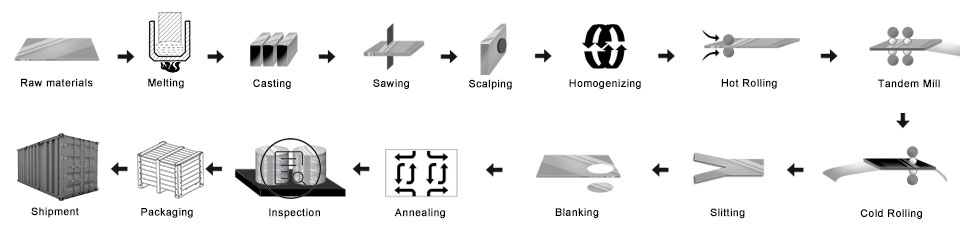
- Prepare the master alloys
- Melting furnace: put the alloys into the melting furnace
- D.C.cast aluminum ingot: To make the mother ingot
- Mill the aluminum ingot: to make the surface and side smooth
- Heating furnace
- Hot rolling mill: made the mother coil
- Colding rolling mill: the mother coil was rolled as the thickness you want to buy
- Punching process: become the size what you want
- Annealing furnace: change the temper
- Final inspection
- Packing: wooden case or wooden pallet
- Delivery
Quality Control
Assurance Below inspection will be done in the production.
- a. ray detection—RT;
- b. ultrasonic testing—UT;
- c. Magnetic Particle Testing-MT;
- d. penetration testing-PT;
- e. eddy current flaw detection-ET
1) Be free from Oil Stain, Dent, Inclusion, Scratches, Stain, Oxide Discoloration, Breaks, Corrosion, Roll Marks, Dirt Streaks, and other defects which will interfere with use.
2) Surface without black line, clean-cut, periodic stain, roller printing defects, such as other gko internal Control standards.
Aluminum discs packing:
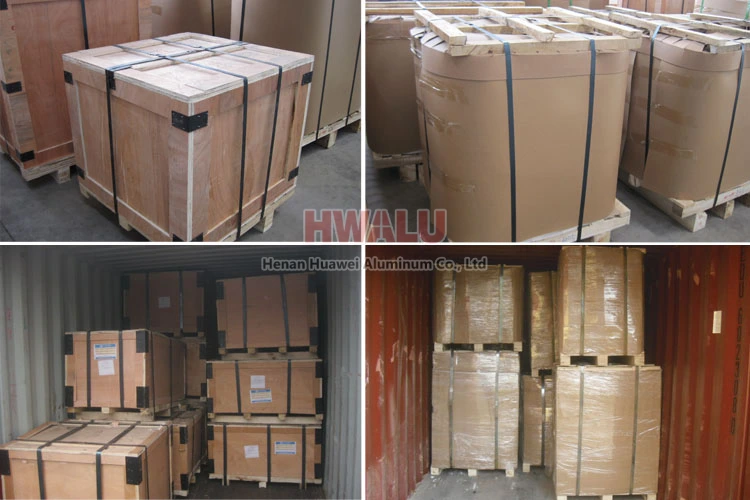
Aluminum circles can be packed by export standards, covering with brown paper and plastic film. Finally, the Aluminium Round is fixed on a wooden pallet/wooden case.
- Put the driers side the aluminum circle, keep the products dry and clean.
- Use clean plastic paper, pack the aluminium circle, keep good sealing.
- Use the snakeskin paper, pack the surface of the plastic paper, keep good sealing.
- Next, there are two ways of packaging: One way is wooden pallet packaging, using the crusty paper packing the surface; Another way is wooden case packaging, using the wooden case packing the surface.
- Finally, lay the steel belt on the wooden box’s surface, keeping the wooden box fastness and secure.
Aluminum circle of Henan Huawei Aluminum. meet the export standard. Plastic film and brown paper can be covered at customers’ needs. What’s more, a wooden case or wooden pallet is adopted to protect products from damage during delivery. There are two kinds of packaging, which are eye to wall or eye to the sky. Customers can choose either of them for their convenience. Generally speaking, there are 2 tons in one package, and loading 18-22 tons in 1×20′ container, and 20-24 tons in 1×40′ container.
Why choose us?
In order to move with the times, HWALU keeps introducing the state of the art equipment and technique to improve its competitiveness. Always adhere to the business philosophy of quality as the center and customer first, to provide the highest quality aluminum disc circle series products to all parts of the world. More …

