Processing Technology and Forming Advantages of 1050 Aluminum Discs in Cookware Manufacturing
1. Introduction: The Role of Aluminum Discs in Cookware Manufacturing
In the modern cookware industry, aluminum has become a primary material thanks to its light weight, excellent thermal conductivity, corrosion resistance, and ease of forming. Among various grades, 1050 aluminum—a commercially pure alloy—stands out for its simplicity in processing and adaptability across cookware products such as pots, frying pans, kettles, and pressure cookers.
A cookware aluminum disc refers to a circular blank made from rolled aluminum sheet, later processed through deep drawing, spinning, and surface treatment to form finished kitchenware. The 1050 alloy, containing 99.5% pure aluminum, ensures superior formability and low hardness, making it ideal for multi-stage forming processes.
As global consumers demand lightweight and energy-efficient cookware, manufacturers increasingly rely on 1050 aluminum discs to balance cost, performance, and manufacturability.

2. Overview of 1050 Aluminum Alloy Properties
The 1050 alloy belongs to the 1000 series of wrought aluminum, known for its high purity and excellent corrosion resistance. It does not respond to heat treatment but can be strengthened through cold working.
Chemical Composition (Typical Values, %)
| Element |
Si |
Fe |
Cu |
Mn |
Mg |
Zn |
Ti |
Al |
| Content (%) |
≤0.25 |
≤0.40 |
≤0.05 |
≤0.05 |
≤0.05 |
≤0.05 |
≤0.03 |
≥99.50 |
Key Mechanical Properties
| Property |
Typical Value |
Description |
| Tensile Strength |
60–100 MPa |
Depends on temper (O, H12, H14) |
| Elongation |
25–40 % |
Excellent ductility |
| Density |
2.71 g/cm³ |
Lightweight structure |
| Thermal Conductivity |
~235 W/m·K |
Efficient heat distribution |
| Melting Point |
660 °C |
Suitable for cookware heating cycles |
These characteristics enable the cookware aluminum disc to be formed repeatedly without cracking or losing dimensional accuracy, ensuring high yield in cookware stamping and spinning operations.
3. Metallurgical Characteristics of 1050 Aluminum
From a metallurgical perspective, 1050 aluminum is a nearly pure face-centered cubic (FCC) structure. This crystalline arrangement grants excellent slip system activity, providing high formability under low stress.
- Grain Structure: Fine and uniform grains improve drawability.
- Corrosion Resistance: The naturally formed Al₂O₃ oxide film prevents oxidation even under high-moisture cooking conditions.
- Thermal Response: Stable conductivity ensures rapid and uniform heat transfer in cooking vessels.
Because 1050 alloy contains no significant strengthening elements, it maintains isotropic deformation behavior, which is critical during deep drawing of cookware aluminum discs.
4. Production Process of 1050 Aluminum Discs
The manufacturing process of 1050 aluminum discs begins with high-purity aluminum ingots and proceeds through multiple stages of melting, casting, rolling, and cutting.
4.1 Process Flow
- Melting and Casting:
High-purity aluminum ingots are melted and refined at 730–760 °C to remove hydrogen and inclusions. The molten metal is cast into slabs using semi-continuous casting.
- Homogenization:
The cast slab is homogenized at 500–550 °C to eliminate segregation and enhance plasticity.
- Hot Rolling:
Slabs are hot-rolled to intermediate thickness (6–8 mm), refining grains and improving surface finish.
- Cold Rolling:
Multiple cold-rolling passes reduce thickness to 0.8–3.0 mm, depending on final disc diameter.
- Blanking:
Circular discs are punched using a CNC blanking machine to achieve dimensional precision.
- Annealing:
Soft-annealing (O temper) restores ductility and relieves internal stress, ensuring the cookware aluminum disc can undergo deep drawing without fracture.
- Surface Cleaning and Packaging:
Degreasing and brushing remove oil residues before packaging for downstream cookware forming lines.

5. Rolling, Annealing, and Cutting Techniques
5.1 Rolling Precision
Modern 4-high or 6-high rolling mills equipped with automatic gauge control (AGC) maintain tight thickness tolerances, typically within ±0.005 mm. Flatness and uniform grain orientation ensure stable forming behavior.
5.2 Annealing Control
Annealing temperature and time are critical. For 1050-O discs, annealing occurs at 350–410 °C for 2–3 hours. Excessive heat may cause grain coarsening, while insufficient annealing leads to poor elongation.
5.3 Cutting and Edge Quality
Laser or rotary shearing systems are employed to minimize burrs. Smooth edges reduce die wear and prevent tearing during spinning or deep drawing—essential for cookware production efficiency.
6. Mechanical Forming: Deep Drawing and Spinning
The forming of a cookware aluminum disc into pots or pans primarily involves deep drawing and spinning.
6.1 Deep Drawing Process
In deep drawing, a flat disc is pulled into a die cavity using a punch, forming cylindrical or hemispherical cookware bodies.
Key parameters include:
- Drawing Ratio: D₀/D₁ ≤ 1.8 for single-stage drawing.
- Lubrication: Synthetic or mineral lubricants reduce friction.
- Blank-Holder Force: Adjusted to prevent wrinkling.
1050 aluminum’s high elongation and low yield strength allow multiple draws without intermediate annealing, improving efficiency.
6.2 Spinning Process
After drawing, spinning refines wall thickness and final shape using CNC or hydraulic spinning machines. This process enhances roundness, distributes material evenly, and enables unique cookware designs.
6.3 Advantages
- Uniform wall thickness.
- High dimensional accuracy.
- Excellent surface finish ready for polishing or anodizing.
7. Surface Treatment and Anodizing in Cookware Applications
Surface finishing enhances both aesthetics and functionality of aluminum cookware.
7.1 Mechanical Polishing
Before anodizing, discs are polished to Ra ≤ 0.2 μm to ensure smooth appearance and easy cleaning.
7.2 Chemical Degreasing and Etching
Alkaline degreasing removes residues; acid etching provides micro-roughness for better anodic coating adhesion.
7.3 Anodizing
Through electrochemical oxidation in sulfuric acid electrolytes, a dense Al₂O₃ layer (thickness 8–20 μm) forms, improving hardness, wear resistance, and corrosion resistance.
7.4 Coloring and Sealing
Anodized cookware can be dyed in metallic tones or sealed to enhance non-stick compatibility. The process creates decorative, durable surfaces with improved heat resistance.
8. Comparison with Other Alloys (1060, 3003, 5052)
Different aluminum alloys are also used in cookware, but each offers unique traits. The following comparison highlights why 1050 aluminum remains a preferred material for cookware aluminum disc production.
| Alloy |
Main Alloying Element |
Tensile Strength (MPa) |
Elongation (%) |
Formability |
Corrosion Resistance |
Cost Level |
Typical Application |
| 1050 |
None (Pure Al ≥ 99.5 %) |
60–100 |
35–40 |
Excellent |
Excellent |
Low |
Pans, Kettles |
| 1060 |
None (Pure Al ≥ 99.6 %) |
70–110 |
30–35 |
Excellent |
Excellent |
Low |
Utensils |
| 3003 |
Mn (1.0–1.5 %) |
110–150 |
20–30 |
Good |
Very Good |
Medium |
Cookware Bodies |
| 5052 |
Mg (2.5%) |
180–230 |
15–25 |
Medium |
Excellent |
Higher |
Pressure Vessels |
8.1 Analysis
- 1050 vs 3003: 1050 offers easier forming, while 3003 provides higher strength. Many manufacturers use 1050 for deep-drawn parts and 3003 for hard-anodized cookware.
- 1050 vs 5052: 5052 offers superior mechanical strength but reduced drawability and higher cost.
Thus, 1050 remains the most cost-effective choice for high-volume cookware production.

9. Thermal and Mechanical Performance Analysis
The performance of cookware largely depends on thermal efficiency and mechanical durability.
The cookware aluminum disc made from 1050 alloy offers an outstanding balance between heat conduction, deformation resistance, and surface stability—three essential aspects for high-performance kitchenware.
9.1 Thermal Conductivity
With a thermal conductivity of approximately 235 W/m·K, 1050 aluminum enables even heat distribution across the cookware base. This prevents localized overheating and supports energy-efficient cooking. Compared with stainless steel (16 W/m·K) and coated iron (55 W/m·K), 1050 aluminum exhibits nearly 15 times greater heat transfer efficiency.
9.2 Thermal Expansion Behavior
The coefficient of linear expansion for 1050 aluminum is around 23.5 × 10⁻⁶/K. This moderate expansion allows the cookware to maintain stable dimensions during rapid heating and cooling, reducing warping and stress concentration.
9.3 Mechanical Stability under Repeated Heating
Long-term thermal cycling tests show minimal degradation in mechanical properties. The yield strength reduction after 1,000 heating cycles (20–300 °C) is less than 5%, indicating excellent heat fatigue resistance. This stability ensures prolonged lifespan for cookware products formed from cookware aluminum discs.
10. Formability and Strength in Multi-Stage Processes
The 1050 alloy’s forming performance is among the best in all aluminum grades used for cookware.
10.1 Deep Drawing Performance
Thanks to its high elongation rate (up to 40%) and uniform grain structure, 1050 aluminum can undergo multiple deep-drawing operations without cracking.
- First Draw: 70–75% depth ratio achievable.
- Second Draw: 85–90% total depth ratio after intermediate annealing.
This property ensures precise wall thickness and smooth internal surfaces, critical for food-grade cookware.
10.2 Spinning Strength Control
During spinning, local deformation occurs through continuous tangential pressure. The strain-hardening effect slightly increases surface hardness (up to 45 HB), which improves wear resistance without compromising ductility.
10.3 Forming Simulation and FEM Optimization
Finite Element Method (FEM) simulations have been increasingly adopted to optimize cookware aluminum disc forming parameters. By analyzing strain distribution and material flow, manufacturers can predict failure zones and optimize punch speed, pressure, and lubrication conditions to minimize defects and maximize yield.
11. Quality Control and Dimensional Accuracy
High-quality cookware demands not only good raw material properties but also stringent process control.
11.1 Thickness and Diameter Tolerance
Precision rolling combined with CNC blanking ensures thickness tolerance within ±0.005 mm and diameter deviation under ±0.2 mm. Consistency at this level prevents unbalanced spinning and ensures smooth press fitting of handles and bases.
11.2 Surface Inspection
Optical inspection systems detect micro-defects such as scratches, stains, or rolling marks at 100% coverage. These automated inspections help ensure that each cookware aluminum disc meets aesthetic and hygienic standards before anodizing.
11.3 Hardness and Conductivity Testing
Hardness is measured using Brinell or Vickers scales, while eddy current testing verifies uniform conductivity. Uniform hardness distribution ensures consistent forming response across the entire disc surface.

12. Environmental Sustainability and Recycling
As global attention shifts toward sustainability, the use of 1050 aluminum in cookware aligns perfectly with environmental objectives.
12.1 Infinite Recyclability
Aluminum is 100% recyclable without loss of performance. Recycling consumes only 5% of the energy required for primary production.
Each ton of recycled cookware aluminum disc material saves over 9 tons of CO₂ emissions.
12.2 Eco-Friendly Surface Treatments
Recent advances in anodizing replace heavy metal-based dyes with organic pigments and waterborne electrolytes. This makes the cookware manufacturing process more sustainable and compliant with EU REACH and RoHS directives.
12.3 Lifecycle Benefits
Cookware made from 1050 aluminum lasts longer, conducts heat efficiently, and is fully recyclable—creating a closed-loop cycle that minimizes waste and resource consumption.
13. Industrial Applications: Pots, Pans, and Kettles
13.1 Sauce Pans and Frying Pans
Due to their thin-wall structure and requirement for even heating, frying pans made from 1050 discs are typically 2.5–3 mm thick. Their lightweight nature provides better handling for domestic and professional kitchens.
13.2 Pressure Cookers
While the pressure-bearing components use stronger alloys like 5052, the outer cover and lid base often employ 1050 discs for cost-efficiency and good surface finish.
13.3 Tea Kettles and Electric Pots
For kettles and electric cookware, 1050 aluminum provides high reflectivity and good heat diffusion. The material’s clean metallic appearance allows mirror polishing and anodized color finishing.
13.4 Multi-Layer Cookware Bases
Many manufacturers bond 1050 aluminum discs with stainless steel through explosive or roll bonding. This hybrid construction combines stainless durability with aluminum heat efficiency, producing induction-compatible cookware.
14. Market Trends and Global Demand Outlook
14.1 Global Production Growth
The global cookware aluminum disc market is projected to exceed USD 1.8 billion by 2032, growing at a CAGR of 5.9%.
Asia-Pacific—especially China, India, and Japan—remains the largest production hub due to cost advantages and mature rolling capabilities.
14.2 Consumer Preference Shifts
- Lightweight Design: Consumers favor easy-to-handle cookware, boosting demand for pure aluminum discs.
- Sustainability: Increased awareness of recyclability and non-toxic surfaces.
- Aesthetic Customization: Demand for anodized, colored, and laser-engraved cookware continues to rise.
14.3 Major Producers
| Company |
Main Product |
Country |
| CHAL Aluminum |
Deep-drawn 1050 cookware discs |
China |
| UACJ Corporation |
Anodizing-grade aluminum blanks |
Japan |
| Constellium |
High-formability aluminum sheets |
France |
| Alcoa |
Recycled aluminum cookware materials |
USA |
| Hindalco Industries |
Rolled and annealed cookware discs |
India |
14.4 Regional Trends
Europe focuses on sustainability certification (EPDs), North America prioritizes lightweight design, and Asia leads in cost-effective large-scale production. These dynamics collectively drive innovation and standardization across the cookware aluminum market.

15. Conclusion: The Strategic Advantages of 1050 Aluminum Discs in Cookware
The integration of 1050 aluminum into cookware manufacturing represents the convergence of material science, cost efficiency, and sustainability.
From rolling precision to deep drawing and anodizing, each stage of production leverages the inherent purity and ductility of this alloy.
Key Advantages Summary
- Exceptional Formability: Suitable for complex multi-stage forming.
- Superior Thermal Conductivity: Ensures efficient and uniform heating.
- Excellent Surface Treatment Response: Ideal for anodizing and polishing.
- Cost-Effectiveness: Provides balance between performance and affordability.
- Environmental Sustainability: Fully recyclable with minimal energy footprint.
As global demand for energy-efficient and eco-friendly cookware continues to rise, the cookware aluminum disc made from 1050 alloy will remain a core material of choice for both traditional and modern kitchenware manufacturing.
Future advancements in digital forming, simulation control, and smart surface treatments will further enhance its application value—positioning 1050 aluminum as a benchmark material in the next generation of sustainable cookware technology.
Properties of the aluminum circle:
Aluminum circle is suitable for many markets, including cookware, automotive and lighting industries, etc., thanks to good product characteristics:
- Low anisotropy, which facilitates deep drawing
- Strong mechanical properties
- High and homogeneous heat diffusion
- Ability to be enameled, covered by PTFE (or others), anodized
- Good reflectivity
- High strength-to-weight ratio
- Durability and resistance to corrosion
Aluminum Circles Process
Ingot/Master Alloys — Melting Furnace – Holding Furnace — D.C. Caster — Slab —- Scalper — Hot Rolling Mill – Cold Rolling Mill – Punching – Annealing Furnace — Final Inspection – Packing — Delivery
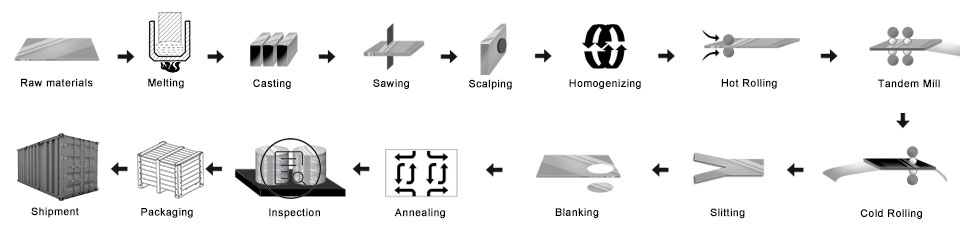
- Prepare the master alloys
- Melting furnace: put the alloys into the melting furnace
- D.C.cast aluminum ingot: To make the mother ingot
- Mill the aluminum ingot: to make the surface and side smooth
- Heating furnace
- Hot rolling mill: made the mother coil
- Colding rolling mill: the mother coil was rolled as the thickness you want to buy
- Punching process: become the size what you want
- Annealing furnace: change the temper
- Final inspection
- Packing: wooden case or wooden pallet
- Delivery
Quality Control
Assurance Below inspection will be done in the production.
- a. ray detection—RT;
- b. ultrasonic testing—UT;
- c. Magnetic Particle Testing-MT;
- d. penetration testing-PT;
- e. eddy current flaw detection-ET
1) Be free from Oil Stain, Dent, Inclusion, Scratches, Stain, Oxide Discoloration, Breaks, Corrosion, Roll Marks, Dirt Streaks, and other defects which will interfere with use.
2) Surface without black line, clean-cut, periodic stain, roller printing defects, such as other gko internal Control standards.
Aluminum discs packing:
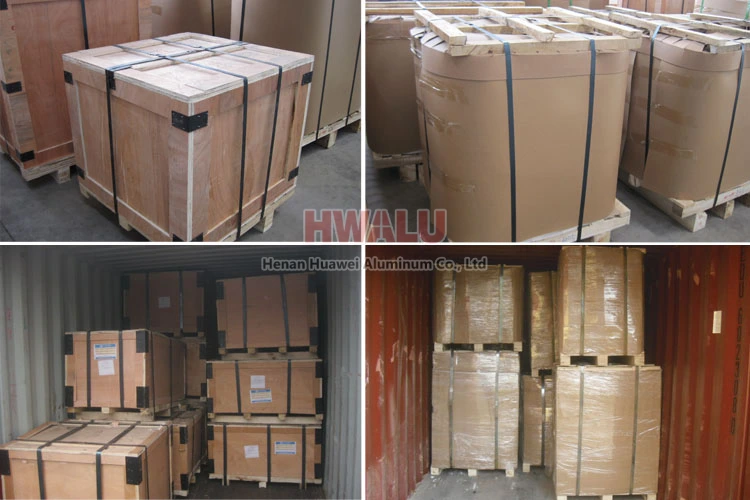
Aluminum circles can be packed by export standards, covering with brown paper and plastic film. Finally, the Aluminium Round is fixed on a wooden pallet/wooden case.
- Put the driers side the aluminum circle, keep the products dry and clean.
- Use clean plastic paper, pack the aluminium circle, keep good sealing.
- Use the snakeskin paper, pack the surface of the plastic paper, keep good sealing.
- Next, there are two ways of packaging: One way is wooden pallet packaging, using the crusty paper packing the surface; Another way is wooden case packaging, using the wooden case packing the surface.
- Finally, lay the steel belt on the wooden box’s surface, keeping the wooden box fastness and secure.
Aluminum circle of Henan Huawei Aluminum. meet the export standard. Plastic film and brown paper can be covered at customers’ needs. What’s more, a wooden case or wooden pallet is adopted to protect products from damage during delivery. There are two kinds of packaging, which are eye to wall or eye to the sky. Customers can choose either of them for their convenience. Generally speaking, there are 2 tons in one package, and loading 18-22 tons in 1×20′ container, and 20-24 tons in 1×40′ container.
Why choose us?
In order to move with the times, HWALU keeps introducing the state of the art equipment and technique to improve its competitiveness. Always adhere to the business philosophy of quality as the center and customer first, to provide the highest quality aluminum disc circle series products to all parts of the world. More …