Tema Aluminum Discs Export for ECOWAS Standard Cookware Production
Tema aluminum discs export for ECOWAS standard cookware production has become a critical topic in the international aluminum cookware trade, profoundly influencing the quality upgrade of the West African Economic Community (ECOWAS) aluminum products market, trade barrier strategies, and regional manufacturing development paths.
 Aluminum Sheet Store
1. Introduction: Global Aluminum Cookware Trade and ECOWAS Market Opportunities
With changes in the global trade landscape, West Africa, as a resource-rich region with enormous consumption potential, has seen a steadily increasing demand for high-quality aluminum cookware. The 15 member states of ECOWAS (Economic Community of West African States) form a market of nearly 400 million people, providing clear guidance and standards for cookware imports and local manufacturing.
Against this backdrop, Tema aluminum discs export for ECOWAS standard cookware production has become a central industry focus. High-precision aluminum discs, as the foundational material for cookware production, directly affect the performance, durability, and food safety level of the final products.
This article aims to provide an in-depth analysis of ECOWAS standards, the technical and trade impact of Tema aluminum discs on cookware production, and, using the success case of Henan Huawei Aluminum Co., Ltd, provide Chinese aluminum exporters with a professional reference framework.
2. Overview of ECOWAS Standards and Industry Requirements
2.1 ECOWAS Market Characteristics and Standard System
In 2018, ECOWAS issued technical standards for aluminum cookware products, covering:
- Raw material composition and alloy specifications
- Surface treatment and corrosion resistance requirements
- Mechanical performance tests for cookware
- Food safety testing protocols
These standards integrate multiple ISO/ANSI standards while considering West African climate, ingredients, and cooking habits, imposing market-targeted requirements on aluminum cookware.
2.2 Positioning of Tema Aluminum Discs in Standards
In ECOWAS standards, Tema aluminum discs are typically used as base materials for stretching, stamping, and deep-processing cookware. Therefore, their alloy composition, mechanical performance, and processing stability are key points:
| Indicator |
ECOWAS Standard Requirement |
Typical Industry Requirement (ISO 80000) |
Notes |
| Alloy Composition |
Al ≥ 98.5% |
Al ≥ 98% |
ECOWAS has stricter food safety requirements |
| Strength (MPa) |
≥ 85 |
≥ 80 |
Prevents high-temperature deformation |
| Elongation (%) |
≥ 10 |
≥ 8 |
Supports stamping and forming |
| Surface Oxide Layer |
Controlled, uniform |
General requirement |
Crucial for corrosion resistance |
As shown, ECOWAS standards impose higher requirements for food contact safety and material consistency than global general standards.
 Measurement of aluminum discs
3. Technical Details of Tema Aluminum Disc Production
3.1 Raw Material Melting and Alloy Optimization
High-quality Tema aluminum disc production begins with a stable aluminum ingot melting system. Key process parameters include:
- Melting temperature controlled between 710°C–740°C to avoid porosity
- Adding trace elements (Mg, Si, Mn) to adjust grain structure and improve strength and toughness
- Casting under gas protection to reduce oxide inclusions
Alloy optimization typically relies on advanced spectrometry and computer simulation to ensure consistent composition.
3.2 Heat Treatment and Performance Enhancement
Heat treatment includes solution treatment and artificial aging to achieve uniform microstructure and excellent mechanical properties. Some high-end products exported to ECOWAS adopt multi-step heat treatment to withstand wide temperature fluctuations and frequent cooking use.
3.3 Surface Treatment and Corrosion Resistance
Anodizing or micro-arc oxidation of Tema aluminum discs significantly enhances corrosion resistance, wear resistance, and adhesion—critical for cookware used in high-acid or high-alkaline environments.
4. Exporting to ECOWAS: Regulatory Compliance and Trade Strategy
4.1 Trade Regulations and Customs Requirements
ECOWAS internal trade enjoys preferential tariffs, but imports require mandatory product certification (ECOWAS Conformity Assessment Programme, ECOWAS CAP). Exporters must provide:
- Material test reports (including food safety testing)
- Mechanical performance and durability testing
- Environmental and packaging declarations
Missing any documentation may lead to customs delays or returns.
4.2 Certification Process and Third-Party Testing
To meet ECOWAS CAP requirements, certification from internationally recognized testing agencies (e.g., SGS, TÜV) is crucial for customs clearance. Henan Huawei Aluminum Co., Ltd has leveraged third-party certification to establish a complete compliance system, enhancing its export competitiveness.
 A large number of aluminum discs
5. Case Study: Henan Huawei Aluminum Co., Ltd
Henan Huawei Aluminum Co., Ltd is a benchmark Chinese aluminum exporter with mature experience in Tema aluminum discs export for ECOWAS standard cookware production. Its success model includes:
5.1 Product R&D and Standards Alignment
The company’s R&D team closely studied ECOWAS standard details, transforming them into internal production control points and establishing an independent quality lab:
| Project |
Standard Requirement |
Huawei Implementation |
| Material Purity |
Al ≥ 98.5% |
Strict alloy composition control |
| Processability |
Elongation ≥ 10% |
Multi-stage heat treatment |
| Surface Requirement |
Corrosion resistance |
Micro-arc oxidation technology |
| Testing Coverage |
Comprehensive |
In-house lab + third-party joint certification |
Through continuous technological investment, the company upgraded product quality from “meeting standards” to “exceeding standards.”
5.2 Market Expansion and Partnership
Henan Huawei Aluminum Co., Ltd participates in international trade fairs and establishes local partnerships in Nigeria, Ghana, and Côte d’Ivoire, building a stable customer base. Its “joint training program” educates local partners about technical advantages and product value.
5.3 Case Results
Over the past three years, the company exported over 50,000 tons of high-quality aluminum cookware materials to ECOWAS countries, achieving an annual export growth rate exceeding 22%, with a market share in Ghana exceeding 18%.
6. Industry Competition and Trend Analysis
Currently, China, India, and Turkey are the main suppliers of aluminum discs to ECOWAS. Comparison between Chinese and Turkish exporters:
| Dimension |
Chinese Enterprises |
Turkish Enterprises |
| Unit Cost |
Medium-Low |
Medium-High |
| Quality Consistency |
High |
Medium |
| Delivery Time |
Controllable |
Variable |
| Customization Service |
High |
Medium |
The data show Chinese companies have advantages in value chain coordination and supply chain responsiveness, while Turkish companies have technical accumulation in certain high-end processes such as deep stamping.
 The packaged aluminum round pieces
7. Frequently Asked Questions (FAQ)
Q1: What are the common compliance challenges for Tema aluminum discs export for ECOWAS standard cookware production?
A1: Mainly food contact safety testing and alloy composition control. ECOWAS requires high-purity aluminum without heavy metal residues, necessitating strict material control and third-party verification.
Q2: How to efficiently complete ECOWAS CAP certification?
A2: Prepare testing samples in advance, select accredited testing agencies, and integrate testing timelines into the overall export plan.
Q3: What should be noted in logistics and customs clearance?
A3: In addition to certification, ensure packaging labels comply with local language requirements, provide certificates of origin, and follow local tariff regulations.
Q4: Can Henan Huawei Aluminum Co., Ltd’s success model be replicated?
A4: Its standardized management, R&D investment, and localized market strategy are universally informative, but implementation should be adapted to resources and market positioning.
8. Conclusion
Tema aluminum discs export for ECOWAS standard cookware production is not only a trade issue but also a comprehensive challenge involving technology, regulation, and market strategy. As the West African market deepens regional integration and consumer upgrades, Chinese aluminum exporters have significant opportunities to enhance product quality, optimize supply chain management, and strengthen compliance services.
By following the successful practices of Henan Huawei Aluminum Co., Ltd, Chinese enterprises can establish their standardized systems, technical advantages, and market trust, securing broader market share in the ECOWAS region.
Properties of the aluminum circle:
Aluminum circle is suitable for many markets, including cookware, automotive and lighting industries, etc., thanks to good product characteristics:
- Low anisotropy, which facilitates deep drawing
- Strong mechanical properties
- High and homogeneous heat diffusion
- Ability to be enameled, covered by PTFE (or others), anodized
- Good reflectivity
- High strength-to-weight ratio
- Durability and resistance to corrosion
Aluminum Circles Process
Ingot/Master Alloys — Melting Furnace – Holding Furnace — D.C. Caster — Slab —- Scalper — Hot Rolling Mill – Cold Rolling Mill – Punching – Annealing Furnace — Final Inspection – Packing — Delivery
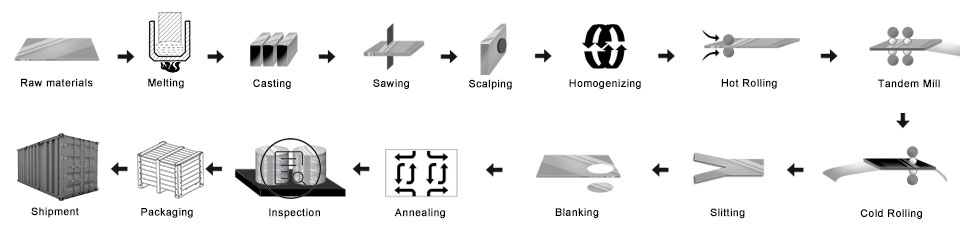
- Prepare the master alloys
- Melting furnace: put the alloys into the melting furnace
- D.C.cast aluminum ingot: To make the mother ingot
- Mill the aluminum ingot: to make the surface and side smooth
- Heating furnace
- Hot rolling mill: made the mother coil
- Colding rolling mill: the mother coil was rolled as the thickness you want to buy
- Punching process: become the size what you want
- Annealing furnace: change the temper
- Final inspection
- Packing: wooden case or wooden pallet
- Delivery
Quality Control
Assurance Below inspection will be done in the production.
- a. ray detection—RT;
- b. ultrasonic testing—UT;
- c. Magnetic Particle Testing-MT;
- d. penetration testing-PT;
- e. eddy current flaw detection-ET
1) Be free from Oil Stain, Dent, Inclusion, Scratches, Stain, Oxide Discoloration, Breaks, Corrosion, Roll Marks, Dirt Streaks, and other defects which will interfere with use.
2) Surface without black line, clean-cut, periodic stain, roller printing defects, such as other gko internal Control standards.
Aluminum discs packing:
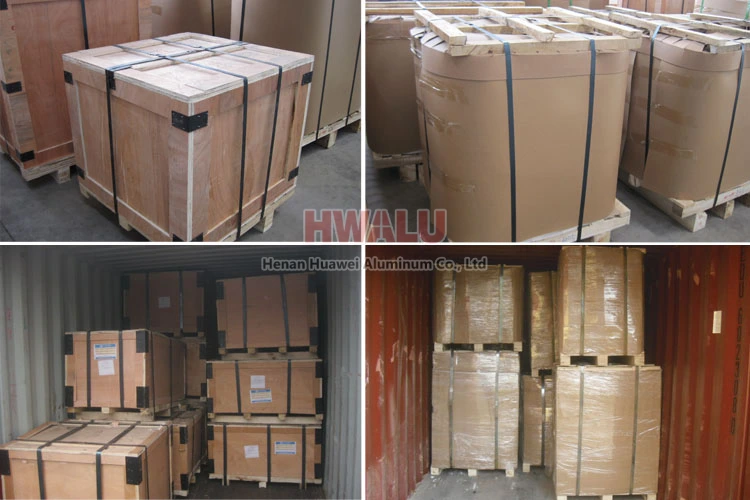
Aluminum circles can be packed by export standards, covering with brown paper and plastic film. Finally, the Aluminium Round is fixed on a wooden pallet/wooden case.
- Put the driers side the aluminum circle, keep the products dry and clean.
- Use clean plastic paper, pack the aluminium circle, keep good sealing.
- Use the snakeskin paper, pack the surface of the plastic paper, keep good sealing.
- Next, there are two ways of packaging: One way is wooden pallet packaging, using the crusty paper packing the surface; Another way is wooden case packaging, using the wooden case packing the surface.
- Finally, lay the steel belt on the wooden box’s surface, keeping the wooden box fastness and secure.
Aluminum circle of Henan Huawei Aluminum. meet the export standard. Plastic film and brown paper can be covered at customers’ needs. What’s more, a wooden case or wooden pallet is adopted to protect products from damage during delivery. There are two kinds of packaging, which are eye to wall or eye to the sky. Customers can choose either of them for their convenience. Generally speaking, there are 2 tons in one package, and loading 18-22 tons in 1×20′ container, and 20-24 tons in 1×40′ container.
Why choose us?
In order to move with the times, HWALU keeps introducing the state of the art equipment and technique to improve its competitiveness. Always adhere to the business philosophy of quality as the center and customer first, to provide the highest quality aluminum disc circle series products to all parts of the world. More …