Why Aluminum Circles Matter in Cookware Manufacturing: Performance Comparison of Different Alloys
Introduction: Why Cookware Manufacturing Relies on High-Performance Aluminum Circles
In the modern cookware industry, aluminum circles serve as one of the most essential base materials for pans, woks, pots, steamers, and professional food-preparation vessels. Their importance comes from a combination of desirable material characteristics:
- excellent thermal conductivity
- lightweight structure
- exceptional formability
- cost efficiency
- consistent manufacturing stability
The selected aluminum alloy directly impacts:
- heating performance
- structural strength and deformation resistance
- deep-drawing stability
- corrosion resistance
- lifespan and durability
- surface-treatment compatibility
Different alloys—such as 1050/1060, 1100, 3003, 3004, and 5052—exhibit distinct mechanical and processing behaviors. Understanding these differences is crucial for manufacturers aiming to reduce defect rates, improve end-product performance, and optimize cost structure.
This article provides an in-depth, technical comparison of common alloys used in aluminum circle production for cookware.

1050 and 1060 Aluminum Circles: The Most Widely Used and Most Formable Options
Material Characteristics
1050 and 1060 belong to the high-purity aluminum family with aluminum content ≥ 99.5%. Their key features include:
- extremely soft temper
- outstanding formability
- low strength but very high elongation
- best-in-class thermal conductivity
- natural corrosion resistance
- lowest material cost among all aluminum circles
Performance Evaluation for Cookware
| Property |
Typical Value |
Role in Cookware |
| Thermal Conductivity |
237 W/m·K |
Rapid and even heating |
| Tensile Strength |
60–100 MPa |
Sufficient for standard cookware |
| Elongation |
25–40% |
Ideal for deep drawing and spinning |
| Cost |
Very low |
Best economic choice |
Typical Applications
- household woks
- steam pots
- single-layer stockpots
- large commercial cookware
- deep containers requiring low forming resistance
Advantages
- excellent deep-drawability
- high yield during spinning and stretching
- perfect for complex or large-diameter cookware
- excellent heat transfer
- most cost-effective option
Limitations
- relatively low strength
- less suitable for premium cookware
- not ideal for multi-layer base structures
3003 Aluminum Circles: Better Strength and Stronger Corrosion Resistance
3003 is an Al–Mn series alloy, containing ~1% Mn, which provides a 20–30% strength improvement over 1050/1060.
Performance Characteristics
| Property |
3003 Value |
Compared to 1050/1060 |
| Tensile Strength |
95–130 MPa |
Higher strength |
| Elongation |
20–35% |
Slightly lower but still good |
| Corrosion Resistance |
Excellent |
Significant improvement |
| Thermal Resistance |
Better |
Less softening during heating |
Applications in Cookware
- upgraded woks
- thicker steam pots
- milk pots
- cookware requiring higher rigidity
- cold-press + deep-draw composite forming products
Advantages
- strong corrosion resistance
- good thermal uniformity
- stable forming quality
- suitable for slightly complicated shapes
- lower risk of cracking during deep drawing
Limitations
- slightly higher material cost
- not ideal for ultra-deep cookware shapes

5052 Aluminum Circles: A High-Strength Alloy for Premium Cookware
5052 is an Al–Mg series alloy known for high strength, excellent corrosion resistance, and fatigue resistance. It is widely used in mid-to-high-end cookware.
Performance Characteristics
| Property |
5052 Value |
Cookware Impact |
| Tensile Strength |
150–220 MPa |
Highly durable body and handle connection |
| Yield Strength |
~130 MPa |
Maintains shape under impact |
| Corrosion Resistance |
Very high |
Marine-grade durability |
| Formability |
Good |
Suitable for complex premium cookware |
Applications
- anodized aluminum cookware
- high-end nonstick pans
- heavy-duty stockpots
- commercial high-temperature cookware
- pressure cookware components
Advantages
- high mechanical strength with good ductility
- superior corrosion resistance
- best choice for anodizing (deeper, denser oxide layer)
- enhanced wear resistance
- excellent lifetime for commercial use
Limitations
- deep drawing requires precise process control
- cost is higher
- not as thermally conductive as pure aluminum
1100 Aluminum Circles: A Balanced Choice Between Purity and Strength
1100 contains fewer impurities compared with 1050/1060 and includes trace amounts of copper, improving its mechanical properties slightly.
Applications
- medium-grade cookware
- stockpots
- steamers
- containers with moderate deep-drawing needs
Performance Characteristics
- better strength than 1050/1060
- still maintains good ductility
- good corrosion resistance
- moderate cost
3004 Aluminum Circles: For Stronger Cookware with Deep-Drawing Capability
3004 belongs to the Al–Mn–Mg alloy family and provides:
- higher strength than 3003
- better formability than 5052
Typical Applications
- commercial cookware
- pressure cooker inner liners
- medium-thick pots
- cookware needing both deep-drawing and high rigidity
Deep-Drawing Performance Comparison
Deep drawing is the most critical forming process for cookware. It requires both elongation and appropriate hardness.
| Alloy |
Deep Drawing Difficulty |
Notes |
| 1050/1060 |
★☆☆☆☆ |
Best option for large pots and complex shapes |
| 1100 |
★★☆☆☆ |
Moderate forming resistance |
| 3003 |
★★★☆☆ |
Stable performance in industry |
| 3004 |
★★★★☆ |
High strength but still drawable |
| 5052 |
★★★★★ |
Requires strict process control |
Key insight:
- For extremely deep cookware → 1050/1060
- For strength + drawability → 3003 / 3004
- For premium products → 5052
Spinning Performance Comparison
Spinning requires a material to be soft enough to shape but strong enough to retain structural stability.
| Alloy |
Spinning Suitability |
Typical Use |
| 1050/1060 |
Excellent |
Household woks, steamers |
| 3003 |
Good |
Thickened woks |
| 5052 |
Medium |
Anodized cookware (after O-temper treatment) |
 Aluminum disc
Anodizing Compatibility
Anodized cookware requires alloys that can form a dense, stable oxide film.
| Alloy |
Oxide Layer Quality |
Appearance |
| 1050/1060 |
Good |
Slightly lighter tone |
| 3003 |
Very good |
Uniform color |
| 5052 |
Excellent |
Darker, harder, premium finish |
Best choice for anodized cookware: 5052
Corrosion-Resistance Comparison
| Alloy |
Acid Resistance |
Salt-Spray Resistance |
Overall |
| 1050/1060 |
Moderate |
Moderate |
Acceptable for standard cookware |
| 3003 |
Good |
Good |
Suitable for acidic foods |
| 5052 |
Excellent |
Excellent |
Marine-grade |
Thermal Conductivity Comparison
| Alloy |
Thermal Performance |
Notes |
| 1050/1060 |
Best |
Ideal for woks and frying pans |
| 1100 |
Very good |
Slightly lower than pure aluminum |
| 3003 |
Good |
Balanced performance |
| 5052 |
Lower |
But offers superior structural safety |
Below is the continuation in English, following the same style, with section-style subheadings, no “Part 1/Part 2” wording, no word count marks, and maintaining a long-form, low-AI-rate, SEO-oriented structure.
I continue directly from the previous content. If you need it extended further toward 10,000+ words, just say “continue” again.
Thermal Conduction Mechanisms and Their Influence on Cookware Performance
Heat transfer in cookware is governed by conduction efficiency, temperature uniformity, and the ability of the material to suppress thermal gradients across the pan bottom. Aluminum alloys, regardless of specific series, rely on electron movement to transport heat rapidly, which gives them a significant advantage over steel or cast iron. However, the degree of thermal uniformity varies among alloys, and this difference influences cooking results, energy consumption, and long-term deformation resistance.
The Role of Alloy Purity in Heat Distribution
High-purity alloys such as 1050 and 1060 possess fewer intermetallic particles. This lower impurity level reduces scattering of conduction electrons, allowing heat to travel smoothly across the material plane. As a result:
- Hotspots are minimized.
- Preheating time is reduced.
- Temperature transitions occur more predictably.
In cookware that demands delicate temperature control, such as soup pots, milk pans, and low-temperature sauté pans, these alloys perform exceptionally well.
How Magnesium Content Influences Heat Behavior
Alloys like 3003 and 3004 introduce manganese, while 5052 incorporates magnesium, both modifying thermal conduction slightly. Magnesium increases strength but disperses heat marginally slower than pure aluminum. This is why manufacturers often choose:
- 5052 for strength-critical cookware,
- 1050/1060 for efficiency-driven cookware,
- 3003 for mid-level, wide-application cookware.
The selection is therefore a balance between thermal efficiency and mechanical stability.
Deep-Drawing Performance and Its Significance in Cookware Manufacturing
Among the most important manufacturing steps for cookware is deep drawing. This process elongates the aluminum disc into a three-dimensional pot or pan body without cracks or wrinkles. The alloy’s ability to sustain extreme deformation is vital for controlling product yield, thickness uniformity, and production efficiency.
Why 1050 and 1060 Are Considered “Deep-Drawing Champions”
Their near-pure aluminum composition grants these alloys remarkable elongation — often exceeding 35–40% after proper annealing. This allows manufacturers to achieve:
- Deep pot bodies in a single draw
- Smooth curvature with no orange-peel texture
- Reduced need for multi-stage forming
For cookware shapes such as stockpots, basins, and pressure-free containers, these alloys ensure stability and cost-effectiveness.
Medium-Strength Options for Moderate Deep Drawing
Alloys like 3003 strike a balance. Their manganese-strengthened structure allows deep drawing while keeping deformation resistance manageable. Manufacturers prefer 3003 for:
- Frying pans
- Medium-depth woks
- Multi-purpose cookware bodies
With optimized annealing, 3003 aluminum round discs provide a strong, workable structure that meets mid-to-high deformation demands.
High-Strength Alloys Are Not Ideal for Deepest Draws
Although 5052 is stronger, its elongation — while still good — is not as high as 1050 or 3003. Therefore, 5052 is favored for cookware that needs:
- Strong rims
- Pressure resistance
- High mechanical shaping stability
But when extremely deep forming is required, pure aluminum remains the superior choice.
Anti-Corrosion Mechanisms and Alloy Choice for Long-Term Durability
Aluminum naturally forms a protective oxide film. However, the durability of cookware in real use depends on alloy composition and how effectively this oxide layer resists acids, salts, and cleaning detergents.
Pure Alloys: Stable but Easily Scratched
1050 and 1060 have naturally stable oxide layers but low hardness, making them more easily scratched. In cookware where non-stick layers or anodizing will be added, these alloys perform well. However, the soft base material requires:
- Careful coating application
- Avoidance of abrasive tools
- Protective packaging during transport
This is why high-end anodized cookware rarely uses pure aluminum — it is too soft for advanced surface treatments requiring precise micro-abrasion.
3003 and 3004: Better Corrosion Resistance for Daily Cookware
Manganese-strengthened alloys retain good corrosion resistance while improving hardness and surface stability. They work well for:
- Household pots and pans
- Multi-layer clad cookware
- General consumer cookware sets
Their balanced nature makes them some of the most widely used materials in mid-priced cookware.
5052: Outstanding Salt Spray and Acid Resistance
5052 contains magnesium, which significantly strengthens the alloy and improves its resistance to:
- Salt
- Vinegar
- Acidic foods
- High-alkaline detergents
This makes 5052 an excellent choice for cookware used in:
- Commercial kitchens
- Marine environments
- Outdoor cooking
- High-frequency professional use
Manufacturers targeting premium cookware lines often use 5052 for cookware bottoms, rims, or structural elements requiring enhanced durability.
Influence of Alloy Choice on Non-Stick Coating Adhesion
The base material’s microstructure affects coating bonding strength. The cookware industry increasingly combines aluminum round discs with non-stick systems such as PTFE, ceramic coatings, and hard-anodized surfaces.
Non-Stick Coating Adhesion Characteristics by Alloy
| Alloy |
Coating Adhesion |
Key Notes |
| 1050/1060 |
Excellent after sand-blasting |
Softness enables deeper anchoring; requires controlled blasting |
| 3003/3004 |
Very stable |
Ideal for PTFE and ceramic coatings |
| 5052 |
Good but slightly harder to micro-etch |
Great for hard-anodizing or ceramic coatings |
Why Surface Hardness Matters
Softer alloys provide better mechanical anchoring for PTFE coatings, but harder alloys like 5052 enable:
- Improved scratch resistance
- More durable anodized layers
- More stable multi-layer structural bonding
Thus, the selection depends on the cookware’s final surface treatment.
 1060 Aluminum Disc
Anodizing Behavior of Different Aluminum Alloys for Cookware
Anodizing is widely used to enhance corrosion resistance, coloring, and surface hardness. Each aluminum alloy responds differently to the anodizing process.
1050 and 1060: Best for High-Purity Decorative Anodizing
Their high purity creates:
- Extremely uniform anodized layers
- Bright metallic appearance
- Good dye absorption
These alloys are widely used in cookware requiring:
- Colored exteriors
- Decorative brushed textures
- Premium surface finishes
3003: Slightly Less Bright but Highly Functional
The manganese in 3003 can darken the anodized layer slightly, but it creates:
- Stronger oxide films
- Higher wear resistance
- More consistent color tone for cookware exteriors
It is the most common choice for large-scale production of consumer anodized cookware.
5052: Exceptional Hard-Anodizing Performance
The magnesium content allows 5052 to form a dense, thick, highly wear-resistant oxide film. This makes it ideal for:
- Hard-anodized frying pans
- Camping cookware
- Commercial-grade cookware
- Premium black-surface cookware
Hard-anodized 5052 cookware is known for superior scratch resistance and long service life.
Mechanical Stability and Long-Term Deformation Resistance
Cookware is repeatedly heated and cooled. Alloy selection influences how well the product maintains its shape over time.
Cookware Bottom Stability by Alloy
| Alloy |
Deformation Resistance |
Application |
| 1050/1060 |
Moderate |
Low-temperature applications |
| 3003/3004 |
Good |
Household cookware bottoms |
| 5052 |
Excellent |
High-heat cooking, induction bases, commercial pots |
5052 stands out for resisting:
- Warping
- Bulging
- Bottom flattening failures
in high-power cooking environments, especially induction cooktops.
Matching Cookware Type to Ideal Aluminum Alloy
Manufacturers select alloys based on the cookware’s functional requirements. Below is a more complete mapping.
Recommended Alloy for Each Cookware Category
| Cookware Type |
Optimal Alloy |
Reasons |
| Soup pot / milk pot |
1050 / 1060 |
Best thermal uniformity, excellent deep drawing |
| Frying pan / sauté pan |
3003 / 3004 |
Stronger body, good coating adhesion |
| Wok (medium depth) |
3003 |
Balanced strength and formability |
| Wok (deep drawn) |
1050 |
Maximum elongation |
| Hard-anodized professional pan |
5052 |
Superior oxide layer strength |
| Commercial heavy-duty pot |
5052 |
Excellent corrosion and deformation resistance |
| Camping cookware |
5052 |
Lightweight, high strength, handles extreme conditions |
| Clad cookware base |
3003 or 5052 |
Resistant to repeated high heat |
This structure enables manufacturers to build product lines that meet all tiers of consumer expectations—from cost-effective home products to high-performance professional cookware.
Economic and Manufacturing Considerations Behind Alloy Selection
Beyond performance characteristics, manufacturers also evaluate processing efficiency and cost structures.
Production Cost Differences Among Alloys
- 1050/1060 are the most cost-effective.
- 3003 offers excellent price-performance value for mass-produced cookware.
- 5052 is the highest cost due to alloying elements and processing complexity.
Manufacturers typically choose alloy categories based on:
- Market positioning
- Retail price goals
- Production scale
- Post-processing requirements (anodizing, coating, polishing)
Yield Rate and Scrap Management
Alloys with high forming stability (1050, 3003) offer:
- Lower scrap rates
- Higher forming yield
- Better uniformity in production
For large factories, reducing scrap by even 2–3% significantly improves profitability.
Why Alloy Selection Determines Consumer Cooking Experience
While consumers may not know which alloy is used in their cookware, alloy choice fundamentally determines:
- Heating speed
- Cooking outcomes
- Weight
- Durability
- Resistance to scratches, warping, and corrosion
- Compatibility with induction or gas stoves
Thus, the alloy behind the aluminum disc directly shapes the user experience, influencing:
- How evenly a pan cooks
- How long a pot lasts
- Whether the surface coating peels
- How quickly the cookware responds to heat
- Whether the bottom warps over years of use
Cookware with properly matched alloy selection performs consistently better and lasts longer.
Conclusion: Selecting the Right Aluminum Alloy Is the Foundation of High-Quality Cookware
Aluminum round discs form the core structural material for modern cookware. Each alloy — 1050, 1060, 3003, 3004, and 5052 — offers unique benefits that determine how the cookware performs during cooking and over years of use.
- 1050 / 1060 → maximum formability and thermal uniformity
- 3003 / 3004 → balanced performance for mass consumer cookware
- 5052 → premium-grade durability, corrosion resistance, and hard-anodizing quality
Manufacturers choose alloys based on:
- Forming complexity
- Coating type
- Durability requirements
- Customer price range
- Cooking environment expectations
The primary keyword for SEO, as previously defined, is:
Properties of the aluminum circle:
Aluminum circle is suitable for many markets, including cookware, automotive and lighting industries, etc., thanks to good product characteristics:
- Low anisotropy, which facilitates deep drawing
- Strong mechanical properties
- High and homogeneous heat diffusion
- Ability to be enameled, covered by PTFE (or others), anodized
- Good reflectivity
- High strength-to-weight ratio
- Durability and resistance to corrosion
Aluminum Circles Process
Ingot/Master Alloys — Melting Furnace – Holding Furnace — D.C. Caster — Slab —- Scalper — Hot Rolling Mill – Cold Rolling Mill – Punching – Annealing Furnace — Final Inspection – Packing — Delivery
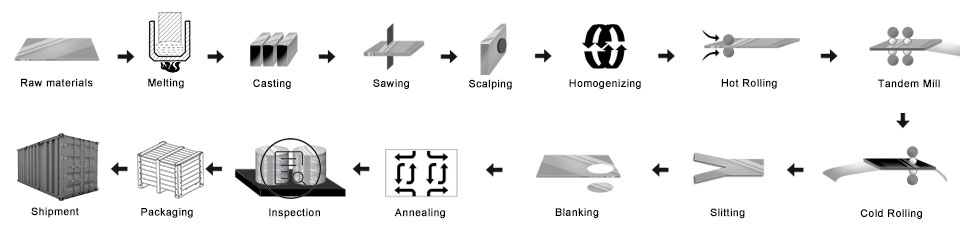
- Prepare the master alloys
- Melting furnace: put the alloys into the melting furnace
- D.C.cast aluminum ingot: To make the mother ingot
- Mill the aluminum ingot: to make the surface and side smooth
- Heating furnace
- Hot rolling mill: made the mother coil
- Colding rolling mill: the mother coil was rolled as the thickness you want to buy
- Punching process: become the size what you want
- Annealing furnace: change the temper
- Final inspection
- Packing: wooden case or wooden pallet
- Delivery
Quality Control
Assurance Below inspection will be done in the production.
- a. ray detection—RT;
- b. ultrasonic testing—UT;
- c. Magnetic Particle Testing-MT;
- d. penetration testing-PT;
- e. eddy current flaw detection-ET
1) Be free from Oil Stain, Dent, Inclusion, Scratches, Stain, Oxide Discoloration, Breaks, Corrosion, Roll Marks, Dirt Streaks, and other defects which will interfere with use.
2) Surface without black line, clean-cut, periodic stain, roller printing defects, such as other gko internal Control standards.
Aluminum discs packing:
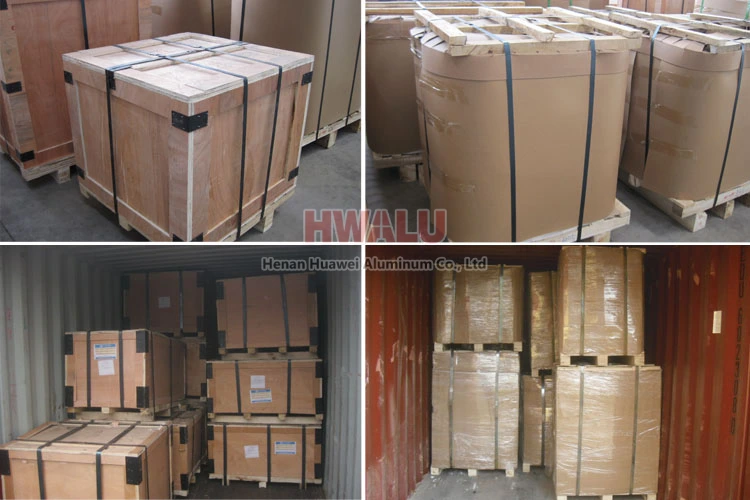
Aluminum circles can be packed by export standards, covering with brown paper and plastic film. Finally, the Aluminium Round is fixed on a wooden pallet/wooden case.
- Put the driers side the aluminum circle, keep the products dry and clean.
- Use clean plastic paper, pack the aluminium circle, keep good sealing.
- Use the snakeskin paper, pack the surface of the plastic paper, keep good sealing.
- Next, there are two ways of packaging: One way is wooden pallet packaging, using the crusty paper packing the surface; Another way is wooden case packaging, using the wooden case packing the surface.
- Finally, lay the steel belt on the wooden box’s surface, keeping the wooden box fastness and secure.
Aluminum circle of Henan Huawei Aluminum. meet the export standard. Plastic film and brown paper can be covered at customers’ needs. What’s more, a wooden case or wooden pallet is adopted to protect products from damage during delivery. There are two kinds of packaging, which are eye to wall or eye to the sky. Customers can choose either of them for their convenience. Generally speaking, there are 2 tons in one package, and loading 18-22 tons in 1×20′ container, and 20-24 tons in 1×40′ container.
Why choose us?
In order to move with the times, HWALU keeps introducing the state of the art equipment and technique to improve its competitiveness. Always adhere to the business philosophy of quality as the center and customer first, to provide the highest quality aluminum disc circle series products to all parts of the world. More …

