Influence of Strength and Ductility on Aluminum Circle Forming Quality
Aluminum circle forming quality is fundamentally determined by the relationship between alloy strength, ductility, and the deformation path during deep drawing, spinning, stamping, or multi-stage forming operations. As manufacturers push for thinner walls, higher forming ratios, and more complex cookware or appliance components, controlling the mechanical behavior of the circle becomes essential for ensuring stable production and minimizing defects.

1. Mechanical Properties That Define Formability
The key mechanical parameters that influence forming behavior include yield strength, tensile strength, elongation, strain-hardening index, and anisotropy. Their combined effect determines whether the aluminum circle can undergo stable plastic deformation without cracking, wrinkling, or excessive thinning.
Manufacturers often balance strength and ductility depending on the application: cookware typically requires high ductility for deep drawing, whereas lighting reflectors may prioritize stiffness and shape retention.
Table 1. Mechanical Property Indicators Affecting Formability
| Property |
Typical Range (1xxx / 3xxx alloys) |
Impact on Forming Behavior |
| Yield Strength (MPa) |
35–130 |
Higher values improve edge stability but reduce deep-draw ability |
| Tensile Strength (MPa) |
70–170 |
Supports structural rigidity but excessive strength raises cracking risk |
| Elongation (%) |
20–40% |
Primary indicator of deep-draw and spinning capability |
| n-Value (Strain Hardening) |
0.15–0.30 |
Higher values distribute strain more uniformly |
| r-Value (Anisotropy) |
0.6–1.0 |
Influences earing and wall thickness uniformity |
2. Strength Effects on Forming Quality
Strength determines how much load the material can withstand before yielding or fracturing. However, higher strength alloys pose challenges during forming:
- They require greater forming force
- They exhibit lower radial stretch capacity
- They intensify localized thinning at punch corners
- They have a reduced tolerance to tooling misalignment
In cookware manufacturing, for example, high-strength conditions such as H14 or H18 may cause early cracking during spinning or deep drawing unless annealed to O-temper. This directly impacts aluminum circle forming quality in high-depth applications such as stockpots, pressure cooker lids, or fire-proof reflector housings.

3. Ductility and Its Role in Stable Forming
Ductility is the capacity to undergo plastic deformation without failure. High-ductility alloys such as 1050-O and 3003-O are widely used because they allow significant strain redistribution.
Ductility directly affects:
- Maximum achievable drawing depth
- Ability to stretch across complex tool geometries
- Crack resistance at sharp radii
- Forming speed (spinning and stamping cycles)
Insufficient ductility typically leads to radial cracks, orange-peel effects, or tearing at the cup wall. By contrast, high ductility helps maintain aluminum circle forming quality throughout demanding production cycles.
4. Interaction Between Strength and Elongation
Strength and elongation must be balanced rather than maximized independently. The ideal forming window varies by application:
- High elongation + medium strength → Best for deep cookware
- Medium elongation + medium/high strength → Best for automotive trim or lighting reflectors
- Low strength + high elongation → Risk of wrinkling or shape collapse
Modern mills adjust alloy composition, processing routes, and annealing schedules to create controlled strength–ductility combinations. The resulting mechanical profile strongly affects aluminum circle forming quality across different forming technologies.
Table 2. Recommended Mechanical Profiles by Application
| Application |
Preferred Alloy/Temper |
Strength (MPa) |
Elongation (%) |
Forming Characteristics |
| Deep cookware (pots, basins) |
1050-O / 1060-O |
Low–medium |
35–40 |
Maximum deep draw capability |
| Pressure cooker lids |
3003-O / 3003-H12 |
Medium |
25–35 |
Good balance of rigidity and drawability |
| Spinning for woks or bowls |
1100-O |
Low–medium |
30–40 |
Smooth deformation under high-speed spinning |
| Lighting reflectors |
1050-H14 |
Medium–high |
15–22 |
Better rigidity, reduced denting |

5. Metallurgical Factors Affecting Strength and Ductility
Several microstructural characteristics determine how an aluminum circle behaves under forming stress:
(1) Grain Size
Fine, uniform grains improve elongation and reduce earing, enhancing aluminum circle forming quality.
(2) Work-Hardening State
Heavily cold-worked material increases strength but reduces ductility. Proper annealing restores formability.
(3) Alloying Elements
- Manganese (3xxx series) increases strength moderately
- Iron and silicon influence grain morphology
- Trace elements control recrystallization behavior
(4) Texture Orientation
Controlled crystallographic texture reduces earing and provides smoother wall thickness distribution.
6. Forming Defects Related to Improper Strength–Ductility Balance
When mechanical properties fall outside the optimal window, common defects include:
- Cracking at the punch radius
- Wrinkling near the flange
- Peel-off or delamination during spinning
- Orange-peel surface caused by coarse grains
- Uneven wall thickness
- High earing ratio
These defects compromise aluminum circle forming quality and lead to higher scrap rates, tool wear, and instability in mass production.
7. Strategies to Improve Forming Quality
Manufacturers can take several actions to enhance product consistency:
Material-Related Measures
- Use O-temper for deep drawing to maximize elongation
- Ensure uniform annealing to eliminate hardness gradients
- Select alloys whose strength–ductility balance fits the forming depth
Process-Related Measures
- Apply optimized lubrication to reduce friction
- Use gradual forming steps rather than a single deep draw
- Adjust die radii to reduce stress concentration
- Monitor strain distribution via forming simulation
Quality-Control Measures
- Perform tensile tests for each batch
- Inspect grain size and texture consistency
- Track hardness across the coil
These techniques collectively enhance aluminum circle forming quality and reduce production risks.
Conclusion
Strength and ductility are the two most critical mechanical factors that determine whether an aluminum circle can withstand complex forming processes without failure. By optimizing alloy selection, temper conditions, microstructure control, and forming parameters, manufacturers can greatly improve aluminum circle forming quality, reduce defect rates, and enhance performance in cookware, lighting, electronics, and industrial applications.
Properties of the aluminum circle:
Aluminum circle is suitable for many markets, including cookware, automotive and lighting industries, etc., thanks to good product characteristics:
- Low anisotropy, which facilitates deep drawing
- Strong mechanical properties
- High and homogeneous heat diffusion
- Ability to be enameled, covered by PTFE (or others), anodized
- Good reflectivity
- High strength-to-weight ratio
- Durability and resistance to corrosion
Aluminum Circles Process
Ingot/Master Alloys — Melting Furnace – Holding Furnace — D.C. Caster — Slab —- Scalper — Hot Rolling Mill – Cold Rolling Mill – Punching – Annealing Furnace — Final Inspection – Packing — Delivery
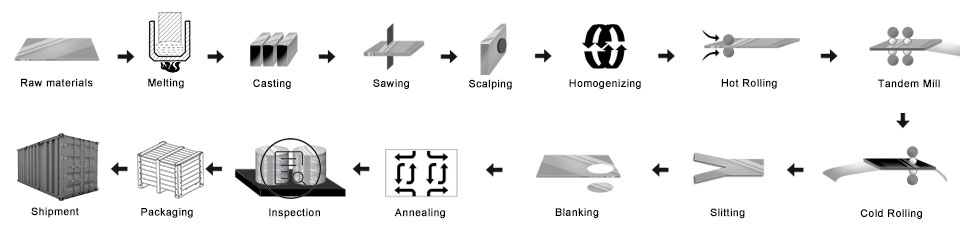
- Prepare the master alloys
- Melting furnace: put the alloys into the melting furnace
- D.C.cast aluminum ingot: To make the mother ingot
- Mill the aluminum ingot: to make the surface and side smooth
- Heating furnace
- Hot rolling mill: made the mother coil
- Colding rolling mill: the mother coil was rolled as the thickness you want to buy
- Punching process: become the size what you want
- Annealing furnace: change the temper
- Final inspection
- Packing: wooden case or wooden pallet
- Delivery
Quality Control
Assurance Below inspection will be done in the production.
- a. ray detection—RT;
- b. ultrasonic testing—UT;
- c. Magnetic Particle Testing-MT;
- d. penetration testing-PT;
- e. eddy current flaw detection-ET
1) Be free from Oil Stain, Dent, Inclusion, Scratches, Stain, Oxide Discoloration, Breaks, Corrosion, Roll Marks, Dirt Streaks, and other defects which will interfere with use.
2) Surface without black line, clean-cut, periodic stain, roller printing defects, such as other gko internal Control standards.
Aluminum discs packing:
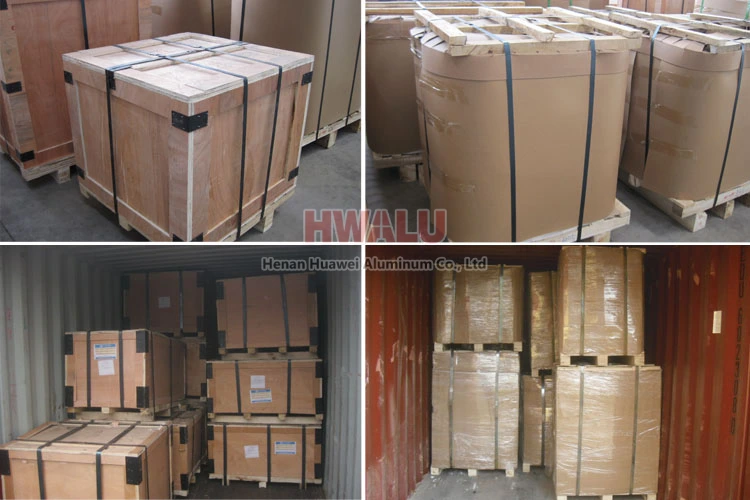
Aluminum circles can be packed by export standards, covering with brown paper and plastic film. Finally, the Aluminium Round is fixed on a wooden pallet/wooden case.
- Put the driers side the aluminum circle, keep the products dry and clean.
- Use clean plastic paper, pack the aluminium circle, keep good sealing.
- Use the snakeskin paper, pack the surface of the plastic paper, keep good sealing.
- Next, there are two ways of packaging: One way is wooden pallet packaging, using the crusty paper packing the surface; Another way is wooden case packaging, using the wooden case packing the surface.
- Finally, lay the steel belt on the wooden box’s surface, keeping the wooden box fastness and secure.
Aluminum circle of Henan Huawei Aluminum. meet the export standard. Plastic film and brown paper can be covered at customers’ needs. What’s more, a wooden case or wooden pallet is adopted to protect products from damage during delivery. There are two kinds of packaging, which are eye to wall or eye to the sky. Customers can choose either of them for their convenience. Generally speaking, there are 2 tons in one package, and loading 18-22 tons in 1×20′ container, and 20-24 tons in 1×40′ container.
Why choose us?
In order to move with the times, HWALU keeps introducing the state of the art equipment and technique to improve its competitiveness. Always adhere to the business philosophy of quality as the center and customer first, to provide the highest quality aluminum disc circle series products to all parts of the world. More …

