Comparative Application Analysis of 1060 Aluminum Discs vs 1100 Aluminum Discs in Modern Manufacturing
1. Introduction
Aluminum discs, also referred to as aluminum circles or round blanks, remain foundational semi-finished materials across cookware manufacturing, electrical housings, pressure-vessel components, and deep-draw packaging. Among the commercially pure aluminum grades, 1060 aluminum discs and 1100 aluminum discs dominate global demand due to their high formability, corrosion resistance, and wide processing adaptability. Despite their similarity as part of the 1xxx series aluminum family, their microstructure, impurity composition, and downstream behavior significantly differ—resulting in distinct application suitability across manufacturing industries.
As lightweight materials continue to replace steel in cookware and consumer products, understanding the nuanced differences between 1060 and 1100 alloys becomes critical for engineers aiming to optimize press performance, reduce scrap rate, and improve end-product reliability. This article conducts a comprehensive technical comparison—including chemical composition, mechanical properties, deep-draw performance, surface quality requirements, thermal behavior, and specific application fields. Through data-driven analysis and detailed manufacturing case studies, we clarify how manufacturers should select between 1060 and 1100 based on process demands, product geometry, production efficiency, and cost considerations.

2. Overview of 1060 Aluminum Discs
1060 aluminum belongs to the commercially pure aluminum category containing 99.6% Al. With ultra-low impurity content, it offers exceptional electrical conductivity and high ductility, making it especially suitable for:
- Deep drawing
- Spinning
- Bending
- Stamping
- Polishing and anodizing applications
It is widely used in cookware (pots, pans, kettles), reflectors, and electronics.
Table 1. Key Characteristics of 1060 Aluminum Discs
| Property Category |
Description |
| Purity |
99.6% aluminum (very high) |
| Mechanical Behavior |
Very soft, excellent ductility, low yield strength |
| Deep Draw Ability |
Outstanding; ideal for large deformation |
| Heat Resistance |
Good for low-to-medium temperature cookware |
| Corrosion Resistance |
High, especially to water and mild chemicals |
| Cost |
Lower than 1100 |
| Common Tempers |
O, H12, H14, H18 |
3. Overview of 1100 Aluminum Discs
1100 aluminum contains 99.0% aluminum, with slightly higher impurities—mainly 0.05–0.20% copper, which improves strength without degrading corrosion performance. Compared with 1060, 1100 offers:
- Higher tensile strength
- Better fatigue resistance
- Slightly reduced formability
- Higher thermal conductivity than some alloyed grades
These characteristics make 1100 suitable for:
- Industrial containers
- Chemical equipment
- Heat exchanger components
- High-pressure cookware and structural housings
Table 2. Key Characteristics of 1100 Aluminum Discs
| Property Category |
Description |
| Purity |
99.0% aluminum |
| Mechanical Behavior |
Stronger than 1060, moderate ductility |
| Deep Draw Ability |
Good but less than 1060 |
| Fatigue Resistance |
Better than 1060 |
| Strength |
Higher due to Cu presence |
| Common Tempers |
O, H14, H16, H18 |
| Ideal Uses |
Pressure vessels, industrial cookware, chemical tanks |
4. Chemical Composition Comparison
Despite both belonging to 1xxx series, the minor elements determine process and application behavior. The presence of copper in 1100 is the primary differentiator, providing enhanced strength and fatigue resistance.
Table 3. Chemical Composition (Typical Values)
| Alloy |
Al (%) |
Cu (%) |
Si (%) |
Fe (%) |
Mn (%) |
Zn (%) |
Others |
| 1060 |
99.6 |
≤0.05 |
≤0.25 |
≤0.35 |
0 |
0 |
≤0.03 |
| 1100 |
99.0 |
0.05–0.20 |
≤0.95 |
≤0.95 |
≤0.05 |
≤0.10 |
≤0.15 |
Key Insight:
The 0.05–0.20% copper content in 1100 significantly enhances strength and pressure resistance, making it suitable for industrial and structural applications where 1060 may deform too easily.
5. Mechanical Properties Comparison
Mechanical behavior directly influences disc performance in stamping, spinning, and deep-drawing operations.
Table 4. Mechanical Properties Comparison (Typical O Temper)
| Property |
1060-O |
1100-O |
| Tensile Strength (MPa) |
55–95 |
70–120 |
| Yield Strength (MPa) |
15–35 |
25–60 |
| Elongation (%) |
30–45 |
25–35 |
| Hardness (HB) |
17–25 |
19–30 |
Key Observations:
- 1060 has superior ductility, making it more suitable for deep-drawing cookware with large deformation (e.g., pots, basin-type cookware).
- 1100 is stronger, ideal for industrial laminations, heavy-duty cookware, and pressure-bearing components.
6. Deep Drawing and Spinning Performance
This section covers real-world processing implications.
6.1 Deep Drawing Behavior
- 1060 aluminum discs perform exceptionally well in single and multi-step drawing due to their softness and high elongation.
- 1100 aluminum discs can also be deep drawn, but tooling wear increases due to higher strength and more frictional resistance.
Table 5. Deep Drawing Performance Rating
| Alloy |
Single Deep Draw |
Multi-Step Deep Draw |
Risk of Cracking |
Typical Applications |
| 1060 |
Excellent |
Excellent |
Very Low |
Pots, pans, lighting reflectors |
| 1100 |
Good |
Moderate |
Low-to-Medium |
Industrial cookware, chemical containers |

7. Surface Treatment Compatibility
Both alloys respond differently during:
- Anodizing
- Polishing
- Coating
- Etching
Polishing Performance
- 1060 achieves a mirror-like surface due to extremely high purity.
- 1100 polishes well but may show slight tone variations because of copper content.
Anodizing Behavior
- 1060 produces more uniform oxide layers, ideal for reflective cookware.
- 1100 gives a harder anodized surface but with slightly darker coloration.
8. Cost and Market Availability
Market Insights
1060 aluminum discs have higher production volumes globally due to their widespread use in cookware and lighting, making them slightly cheaper.
Table 6. Cost Comparison (Approx. Industry Ratios)
| Alloy |
Relative Price |
Market Availability |
Global Demand |
| 1060 |
Low |
Very High |
Very High |
| 1100 |
Medium |
High |
High |
9. Application Suitability Differences
This is the most important part for engineers selecting between the two alloys.
9.1 Applications Ideal for 1060 Aluminum Discs
- Standard household cookware
- Kettle bodies
- Flexible lighting reflectors
- Deep-draw food containers
- Fan blades
- Aluminum signs
- Low-strength industrial housings
9.2 Applications Ideal for 1100 Aluminum Discs
- High-pressure cookware
- Chemical storage tanks
- Pipe insulation jackets
- Industrial heat exchangers
- Multi-layer cookware bottoms
- High-temperature industrial reflectors
- Heat-resistant packaging materials
Table 7. Application Recommendation Matrix
| Application Type |
1060 Recommendation |
1100 Recommendation |
| Household cookware |
★★★★★ |
★★★ |
| Industrial cookware |
★★★ |
★★★★★ |
| Chemical containers |
★★ |
★★★★★ |
| Reflectors |
★★★★★ |
★★★ |
| Deep-draw food packaging |
★★★★★ |
★★★ |
| High-pressure vessels |
★★ |
★★★★★ |
| Spinning-intensive components |
★★★★★ |
★★★ |
10. Thermal Conductivity and Heat Distribution
Both alloys exhibit excellent thermal conductivity, but slight differences matter in heat-sensitive applications.
Thermal Characteristics
- 1060 provides highly uniform heat distribution—ideal for even-heating cookware.
- 1100 offers slightly lower thermal uniformity but better mechanical stability under temperature fluctuations.
Table 8. Thermal Property Comparison
| Property |
1060 |
1100 |
| Thermal Conductivity (W/m·K) |
234 |
222 |
| Heat Capacity |
High |
High |
| Heat Deformation Resistance |
Moderate |
Higher |
11. Formability, Work Hardening Behavior, and Processing Response
Understanding how 1060 and 1100 aluminum discs react during mechanical operations is essential for manufacturers seeking high forming efficiency, low scrap rate, and consistent product geometry. The forming mechanisms, work-hardening characteristics, and rate of strain sensitivity vary significantly between both alloys.
11.1 Work Hardening Characteristics
Aluminum alloys strengthen during cold working as dislocations multiply, improving hardness but reducing ductility. The degree of work hardening differentiates the alloys:
Table 9. Work Hardening Comparison
| Alloy |
Work Hardening Rate |
Softness Retention |
Suitability for Multiple Drawing Steps |
| 1060 |
Low |
High |
Excellent |
| 1100 |
Medium |
Moderate |
Good but more tool wear |
Analysis:
- 1060’s work hardening rate is low, meaning that even after substantial deformation, it retains ductility and does not become brittle.
- 1100 work hardens more rapidly due to its copper content, improving strength but requiring intermediate annealing for multi-stage deep drawing.
11.2 Strain Rate Sensitivity
Strain rate sensitivity controls how the alloy responds under fast vs. slow deformation.
- 1060 aluminum exhibits a stable response at varying strain rates, allowing rapid stamping without risk of localized thinning.
- 1100 aluminum performs better at slower, controlled draw speeds where its higher work hardening can be leveraged for structural integrity.
This is why 1060 is ideal for automated high-speed cookware stamping lines, while 1100 is preferred in industrial tank forming operations where draw depth is moderate but structural strength is critical.
12. Annealing Behavior and Temper Compatibility
Annealing softens the alloy after cold working, restores ductility, and stabilizes grain structure. Processing engineers must select the correct temper to maximize performance.
12.1 Annealing Characteristics
Table 10. Annealing Response
| Alloy |
Full Anneal Temperature |
Holding Time |
Grain Size Uniformity |
Post-Anneal Ductility |
| 1060 |
350–410°C |
1–2 hours |
Very high |
Excellent |
| 1100 |
350–430°C |
1–3 hours |
High |
Very good |
Key Notes:
- 1100 requires a slightly wider temperature range and longer holding time due to copper-related recrystallization behavior.
- 1060 achieves uniform, fine grains that enhance deep draw capability.
12.2 Common Tempers Used in Manufacturing
Table 11. Common Tempers and Their Applications
| Temper |
1060 Applications |
1100 Applications |
| O |
Deep-draw cookware, reflectors |
Pressure cookware, chemical tanks |
| H12 |
Medium draw components |
Structural housings |
| H14 |
Spinning products |
Medium-strength food containers |
| H18 |
Signs, nameplates |
Industrial insulation jackets |
Tempering greatly influences product selection. For example:
- A 1060-O disc is ideal for a kettle body requiring multiple drawing operations.
- An 1100-H14 disc is better for industrial heat shields needing moderate structural rigidity.

13. Surface Quality Requirements and Reflectivity
Surface finish impacts both aesthetics and performance, especially in cookware, lighting reflectors, and decorative applications.
13.1 Reflectivity Performance
Table 12. Reflectivity Differences
| Alloy |
Polished Reflectivity |
Anodized Reflectivity |
Best Use |
| 1060 |
Very High |
Very High |
Lighting, cookware interiors |
| 1100 |
High |
Moderate |
Industrial reflectors, housings |
Why 1060 performs better:
Ultra-high aluminum purity reduces micro-defects, enabling mirror-grade polishing.
13.2 Surface Roughness After Stamping
Table 13. Surface Roughness (Ra) After Forming
| Alloy |
Single Draw Ra (µm) |
Multi-Draw Ra (µm) |
Spinning Ra (µm) |
| 1060 |
0.25–0.35 |
0.30–0.45 |
0.25–0.30 |
| 1100 |
0.30–0.45 |
0.35–0.55 |
0.28–0.40 |
Lower Ra values correlate with:
- Better coating adhesion
- Higher reflectivity
- Reduced friction in cookware interior surfaces
1060 therefore excels in premium cookware and lighting.
14. Strength, Fatigue Resistance, and Structural Behavior
Fatigue resistance is a critical factor in applications involving cyclic loads, mechanical vibration, or thermal cycling.
14.1 Strength Difference Explained
1100’s slight copper addition increases:
- Tensile strength
- Yield strength
- Fatigue resistance
This makes it better suited for:
- Pressure cookers
- Industrial tank lids
- Load-bearing housings
Table 14. Structural Performance Comparison
| Performance Category |
1060 |
1100 |
| Static Load Strength |
Medium |
High |
| Vibration Fatigue |
Medium |
High |
| Thermal Fatigue |
Medium |
High |
| Impact Resistance |
High |
Medium |
15. Corrosion Behavior and Chemical Resistance
Both alloys resist corrosion well, but differences arise in specific environments.
15.1 General Corrosion Performance
- 1060: Excellent resistance to water, steam, organic acids
- 1100: Also excellent, with slightly reduced resistance in chloride-heavy environments due to Cu presence
Table 15. Corrosion Suitability
| Application Environment |
1060 Suitability |
1100 Suitability |
| Neutral water |
★★★★★ |
★★★★★ |
| Food acids |
★★★★★ |
★★★★ |
| Chlorides |
★★★★ |
★★★ |
| Industrial chemicals |
★★★ |
★★★★★ |
| Atmospheric exposure |
★★★★★ |
★★★★★ |
16. High-Temperature Behavior and Thermal Cycling
16.1 Heat Resistance Comparison
1060 maintains excellent thermal conductivity but may deform under repeated high-heat cycles due to softness.
1100, possessing greater strength, better maintains shape under:
- High flame temperatures
- Thermal gradients
- Rapid heating-cooling cycles
This is why industrial cookware manufacturers often choose 1100 for pressure cooker lids while selecting 1060 for kettle bodies.
17. Welding, Brazing, Joining, and Coating Behavior
Manufacturers must consider compatibility with joining techniques.
17.1 Weldability
Both alloys are easy to weld using:
- TIG
- MIG
- Resistance welding
However:
- 1060 produces cleaner weld zones
- 1100 provides stronger welds due to copper-induced strength gain
Table 16. Welding Behavior
| Property |
1060 |
1100 |
| Weld Cleanliness |
Excellent |
Good |
| Weld Strength |
Medium |
High |
| Post-Weld Formability |
Excellent |
Moderate |

18. Performance in Cookware Manufacturing (Deep Analysis)
Cookware remains the largest consumption sector for aluminum discs globally.
18.1 Why 1060 Dominates Household Cookware
Reasons include:
- Ultra-high elongation reduces cracking risk
- Smooth surface ideal for polishing or coating
- High thermal conductivity ensures even heating
- Lower cost improves competitiveness
- Ideal for large deformation in pots and pans
18.2 Why 1100 Is Popular in Industrial or High-Pressure Cookware
Manufacturers choose 1100 when:
- Strength requirements exceed 1060’s capacity
- Cookware needs fatigue resistance (pressure vessels)
- Multiple thermal cycles occur in industrial environments
- Dimensional stability is critical under load
19. Industrial Applications: Chemical, HVAC, and Structural
19.1 Chemical Storage Applications
1100 aluminum discs are preferred for:
- Chemical tank end caps
- Gas lids
- Insulation jacketing
- HVAC flange discs
The added copper enhances structural integrity without drastically reducing corrosion resistance.
19.2 HVAC and Heat Exchanger Components
Aluminum’s thermal properties make both alloys suitable, but:
- 1060 is used where reflectivity and formability matter
- 1100 is used where strength and vibration fatigue are key
20. Lighting, Reflector, and Decorative Applications
20.1 Reflector Production
Lighting reflectors require:
- High reflectivity
- Smooth surface
- Excellent spin-forming capability
This is where 1060 excels overwhelmingly.
Table 17. Reflector Material Rating
| Performance Category |
1060 Rating |
1100 Rating |
| Polishing |
★★★★★ |
★★★★ |
| Surface Brightness |
★★★★★ |
★★★ |
| Spin Formability |
★★★★★ |
★★★★ |
| Weight Optimization |
★★★★★ |
★★★★★ |
21. Sustainability, Recyclability, and Environmental Considerations
Both alloys are highly recyclable, with more than 90% recyclability rate after end-of-life processing.
However:
- 1060 is easier to recycle due to fewer alloying elements.
- 1100 requires slightly more refining due to copper but yields stronger recycled products.
22. Real-World Case Studies (Manufacturing Examples)
Case Study 1: Cookware Factory in Vietnam
A major cookware manufacturer transitioned from:
- 1100 for kettle bodies → 1060
Reason:
- Switching to 1060 reduced cracking rate during deep drawing from 3.2% to 0.4%
- Increased production speed
- Improved mirror polishing quality
Case Study 2: Industrial Pressure Vessel Brand in Turkey
Switched from:
- 1060 to 1100 for industrial cooker lids
Outcome:
- Strength increased by 18%
- Vessel lifetime extended by 22%
- Compliance with pressure vessel norms improved
Properties of the aluminum circle:
Aluminum circle is suitable for many markets, including cookware, automotive and lighting industries, etc., thanks to good product characteristics:
- Low anisotropy, which facilitates deep drawing
- Strong mechanical properties
- High and homogeneous heat diffusion
- Ability to be enameled, covered by PTFE (or others), anodized
- Good reflectivity
- High strength-to-weight ratio
- Durability and resistance to corrosion
Aluminum Circles Process
Ingot/Master Alloys — Melting Furnace – Holding Furnace — D.C. Caster — Slab —- Scalper — Hot Rolling Mill – Cold Rolling Mill – Punching – Annealing Furnace — Final Inspection – Packing — Delivery
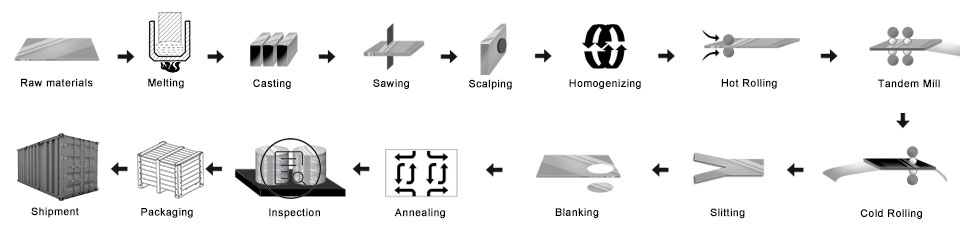
- Prepare the master alloys
- Melting furnace: put the alloys into the melting furnace
- D.C.cast aluminum ingot: To make the mother ingot
- Mill the aluminum ingot: to make the surface and side smooth
- Heating furnace
- Hot rolling mill: made the mother coil
- Colding rolling mill: the mother coil was rolled as the thickness you want to buy
- Punching process: become the size what you want
- Annealing furnace: change the temper
- Final inspection
- Packing: wooden case or wooden pallet
- Delivery
Quality Control
Assurance Below inspection will be done in the production.
- a. ray detection—RT;
- b. ultrasonic testing—UT;
- c. Magnetic Particle Testing-MT;
- d. penetration testing-PT;
- e. eddy current flaw detection-ET
1) Be free from Oil Stain, Dent, Inclusion, Scratches, Stain, Oxide Discoloration, Breaks, Corrosion, Roll Marks, Dirt Streaks, and other defects which will interfere with use.
2) Surface without black line, clean-cut, periodic stain, roller printing defects, such as other gko internal Control standards.
Aluminum discs packing:
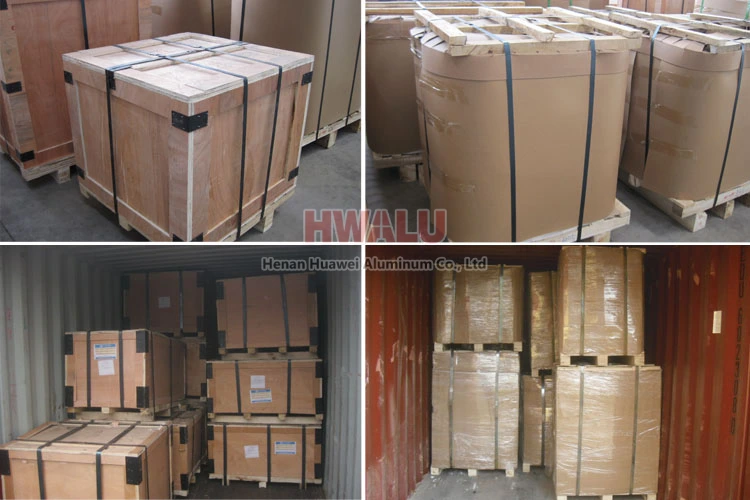
Aluminum circles can be packed by export standards, covering with brown paper and plastic film. Finally, the Aluminium Round is fixed on a wooden pallet/wooden case.
- Put the driers side the aluminum circle, keep the products dry and clean.
- Use clean plastic paper, pack the aluminium circle, keep good sealing.
- Use the snakeskin paper, pack the surface of the plastic paper, keep good sealing.
- Next, there are two ways of packaging: One way is wooden pallet packaging, using the crusty paper packing the surface; Another way is wooden case packaging, using the wooden case packing the surface.
- Finally, lay the steel belt on the wooden box’s surface, keeping the wooden box fastness and secure.
Aluminum circle of Henan Huawei Aluminum. meet the export standard. Plastic film and brown paper can be covered at customers’ needs. What’s more, a wooden case or wooden pallet is adopted to protect products from damage during delivery. There are two kinds of packaging, which are eye to wall or eye to the sky. Customers can choose either of them for their convenience. Generally speaking, there are 2 tons in one package, and loading 18-22 tons in 1×20′ container, and 20-24 tons in 1×40′ container.
Why choose us?
In order to move with the times, HWALU keeps introducing the state of the art equipment and technique to improve its competitiveness. Always adhere to the business philosophy of quality as the center and customer first, to provide the highest quality aluminum disc circle series products to all parts of the world. More …

