Why Aluminum Circles Tend to Crack During Deep Drawing or Spinning — Causes and Complete Prevention Guide
Introduction: Why “Cracking” Has Become the Biggest Bottleneck in Aluminum Circle Forming
As the cookware and lighting industries continue to shift toward lightweight metal forming, deep-drawn cookware bodies, pressure cooker inner pots, reflectors, lampshades, and storage vessels place increasingly higher demands on the formability of aluminum circles. However, in daily production, cracking, tearing, excessive earing, orange-peel texture, and edge breakage still occur frequently. These defects reduce yield rates by 20–40% in many factories, severely affecting output stability.
Manufacturers often ask:
- Why do aluminum circles with the same alloy and thickness perform differently during forming?
- Why do edges tend to crack first during deep drawing?
- Why does the arc (R-zone) crack suddenly during spinning?
- What is the systematic method to eliminate cracking from materials, annealing, dies, lubrication, and parameter control?
This article explains in engineering depth the mechanisms behind aluminum circle cracking, the material causes, process-related causes, and comprehensive solutions from an end-to-end production perspective.

Part 1 — Why Do Aluminum Circles Crack During Deep Drawing or Spinning? (Mechanism Analysis)
1. Material-Related Causes
1. Alloy Composition Determines Deformation Capacity
Different aluminum alloys have very different stretchability:
| Alloy |
Elongation |
Deep Drawing Performance |
Typical Uses |
| 1050 / 1060 |
30–40% |
⭐⭐⭐⭐⭐ Excellent |
Cookware, reflectors |
| 1100 |
25–35% |
⭐⭐⭐⭐ |
Lids, cookware |
| 3003 |
20–28% |
⭐⭐⭐ |
Higher-strength cookware |
| 5052 |
12–20% |
⭐⭐ |
Structural parts, limited drawability |
Higher contents of Mn or Mg increase strength but reduce elongation, making cracking more likely.
Thus:
- 1050/1060 are the best alloys for deep drawing
- 3003 is usable only with well-controlled annealing
- 5052 is high strength but risky for deep drawing
2. Non-uniform Mechanical Properties (Uneven Hardness or Thickness)
Cracking can occur when:
- Internal stress distribution is uneven
- Thickness deviation is large
- Edge hardness is significantly higher than the center
- Cold-work hardening remains due to insufficient annealing
The edge area is the most common weak point.
3. Coarse or Elongated Grains Cause Early Crack Initiation
Grain structure determines formability:
- Fine grains = excellent formability
- Coarse grains = higher brittleness, easier cracking
- Strong grain orientation leads to earing, stress concentration, and cracks
Typical metallurgical defects that increase crack risk:
- Coarse grains
- Elongated grains
- Strong rolling texture
- Excessive precipitates

2. Process-Related Causes
1. Excessive Drawing Ratio (DR)
Deep drawing ratio (DR):
DR = blank diameter / cup diameter
- When DR > 2.1, aluminum circles are highly likely to crack.
2. Restricted Material Flow = Forced Stretching = Cracking
Cracking happens when metal cannot flow smoothly into the die cavity.
Common reasons:
- Excessive blank-holder force
- Insufficient blank-holder force (causing wrinkles → later tearing)
- Poor lubrication (high friction → tearing)
3. Improper Die Radius (R-Value)
A small R-angle is the No.1 reason for cracking.
- Small die radius → stress concentration → R-zone cracks in 90% of cases
- Tight punch-die clearance
- Abrupt transition angles
Recommended R values:
| Application |
R Value |
Note |
| Deep drawing |
4–8 × thickness |
Too small → guaranteed cracking |
| Second draw |
6–10 × thickness |
Larger R is better |
| Blank-holder R |
3–5 × thickness |
Too small may cause edge injury |
4. Poor Lubrication Causes Tearing
Insufficient lubrication leads to:
- Scratches
- Galling
- Severe friction
- Tearing at the R-zone or walls
Use:
- High-pressure deep drawing oils
- Graphite-based lubricants
- Food-grade lubricants for cookware
5. Spinning-Related Force Imbalance
Cracks in spinning commonly occur in:
- R-zone
- Bottom-to-wall transition area
- Flanging area
Causes:
- Excessive roller pressure
- Too fast feed rate
- High localized heating → work hardening
- Starting thickness too thin
3. Equipment-Related Causes
1. Poor Machine Precision
- Eccentric ram
- Machine vibration
- Uneven force distribution
→ Cracking during forming.
2. Worn Dies or Blank Holders
Wear introduces:
- Burrs
- Scratches
- Localized grabbing of metal
Leading to premature cracking.
Part 2 — How to Prevent Cracking During Deep Drawing or Spinning
1. Material Control (The Most Important Factor)
1. Selecting the Right Alloy
| Application |
Recommended Alloy |
Reason |
| Standard cookware deep drawing |
1050 / 1060 |
Highest elongation |
| Higher strength cookware |
3003 |
Stronger yet workable |
| Spinning |
1060 / 3003 |
Good flowability |
Strengthened tempers (H14/H24) cannot be deep drawn.
Use O-temper only.
2. Correct Annealing (Solves 80% of Cracking Problems)
Annealing target:
- Remove cold-work hardening
- Restore ductility
- Balance mechanical properties
Recommended:
| Parameter |
Value |
| Temp |
350–420°C |
| Soak time |
2–6 hrs |
| Cooling |
Slow cooling |
Under-annealed:
- High edge hardness
- R-zone tearing
- Roller marks
Over-annealed:
- Coarse grains
- Orange-peel surface
3. Thickness and Hardness Control
| Requirement |
Recommended |
| Thickness tolerance |
±0.01–0.02 mm |
| Hardness uniformity |
< 5HB difference |
| Edge hardness |
Must be close to center |
2. Die Optimization
1. Proper R-Radius Design
Use:
Where t = sheet thickness.
2. Proper Clearance
Recommended:
- 1.08–1.12t for first draw
- 1.15–1.20t for redrawing
3. Controlled Blank-holder Force
- Too much → restricted flow → cracking
- Too little → wrinkling → later tearing
Use hydraulic or CNC-controlled systems when possible.
3. Lubrication & Surface Treatment
Good lubrication reduces friction 3–5×.
Recommended:
- High-pressure deep-drawing oils
- Graphite lubricants
- Food-grade oils for cookware production
4. Deep Drawing Parameter Optimization
| Parameter |
Recommendation |
| Drawing speed |
Medium |
| Blank-holder force |
Gradually tuned |
| Second draw |
Only after annealing |
| Punch speed |
Slower in second half |
5. Spinning Parameter Optimization
| Parameter |
Influence |
Adjustment |
| Roller pressure |
Excessive → cracking |
Reduce |
| Feed rate |
Too fast causes tearing |
Reduce |
| Rotation speed |
Too high → hardening |
Medium |
| Heating |
Improves plasticity |
Recommended for 3003/5052 |
6. Using “Pre-forming + Deep Drawing” Combination
Steps:
- Pre-stretching
- Pre-bending
- Drawing in two stages
- Intermediate annealing
This reduces cracking by over 60%.

Part 3 — Common Cracking Types and How to Diagnose Them
1. Edge Cracking (Most Common)
Causes:
- High edge hardness
- Insufficient annealing
- Thickness deviation
Solutions:
- Test edge hardness
- Ensure complete annealing
- Reduce blank-holder force
2. R-Zone Cracking
Cause:
- Small R-radius
- High friction
- Stress concentration
Solution:
- Increase die R
- Improve lubrication
- Reduce drawing speed
3. Straight-Line Cracking
Cause:
- Strong rolling texture
- Grain elongation
Solution: Change to better-quality material.
4. Orange-Peel Surface Cracking
Cause:
- Over-annealing
- Coarse grains
5. Spinning Cracks at Transition Zone
Cause:
- Imbalanced roller force
- Thin starting thickness
6. Flanging Cracks
Cause:
- Large angle transition
- Insufficient thickness
Part 4 — Complete Factory-Level Solution (From Coil to Final Product)
1. Raw Material (Aluminum Coil)
Key requirements:
- Alloy: 1050/1060-O, 3003-O
- Grain size: 50–100 μm
- Thickness tolerance: ±0.01 mm
- Hardness variation < 5HB
2. Cleaning and Blanking
- Oil removal
- Scratch prevention
- High-precision circle cutting
3. Annealing
Ideal:
- 380–420°C
- 4 hours soaking
- Slow cooling
4. Pre-forming Preparation
- Even lubrication
- Mold preheating
- Blank-holder inspection
5. Deep Drawing
- First draw controls DR
- Anneal before second draw
- Fine-tune blank-holder force
6. Spinning
- Multi-stage forming
- Smooth roller surface
- Auxiliary heating when needed
7. Final Inspection
- Visual inspection
- Thickness mapping
- Forming height
- Expansion test
Part 5 — Engineering Case Studies
Case 1 — 3003 Aluminum Circles Cracking in Deep-Drawn Cookware
Issue:
- Edge hardness high by 10–15HB
- Under-annealed
Solution:
- Increase annealing soak time
- Add intermediate annealing before second draw
- Reduce blank-holder force by 15%
Result:
- Crack rate reduced from 22% → 1.5%
Case 2 — 1060 Circles Cracking in Spun Pressure Cooker Lid
Issue:
- Uneven roller pressure at R-zone
- Starting thickness too thin
Solution:
- Correct roller pressure curve
- Increase thickness 1.3 → 1.4 mm
Result:
- Crack rate reduced from 18% → 0.8%
Conclusion: A System-Level Strategy Is Required to Eliminate Cracking
Cracking during deep drawing or spinning is not caused by a single factor. It is the combined effect of:
- Material structure
- Annealing precision
- Die design
- Lubrication
- Process parameters
- Equipment accuracy
Only when these factors are optimized together can manufacturers fundamentally solve aluminum circle cracking in deep drawing and significantly increase yield rates.
Properties of the aluminum circle:
Aluminum circle is suitable for many markets, including cookware, automotive and lighting industries, etc., thanks to good product characteristics:
- Low anisotropy, which facilitates deep drawing
- Strong mechanical properties
- High and homogeneous heat diffusion
- Ability to be enameled, covered by PTFE (or others), anodized
- Good reflectivity
- High strength-to-weight ratio
- Durability and resistance to corrosion
Aluminum Circles Process
Ingot/Master Alloys — Melting Furnace – Holding Furnace — D.C. Caster — Slab —- Scalper — Hot Rolling Mill – Cold Rolling Mill – Punching – Annealing Furnace — Final Inspection – Packing — Delivery
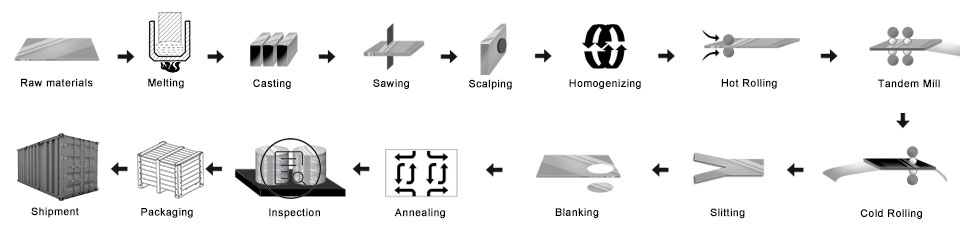
- Prepare the master alloys
- Melting furnace: put the alloys into the melting furnace
- D.C.cast aluminum ingot: To make the mother ingot
- Mill the aluminum ingot: to make the surface and side smooth
- Heating furnace
- Hot rolling mill: made the mother coil
- Colding rolling mill: the mother coil was rolled as the thickness you want to buy
- Punching process: become the size what you want
- Annealing furnace: change the temper
- Final inspection
- Packing: wooden case or wooden pallet
- Delivery
Quality Control
Assurance Below inspection will be done in the production.
- a. ray detection—RT;
- b. ultrasonic testing—UT;
- c. Magnetic Particle Testing-MT;
- d. penetration testing-PT;
- e. eddy current flaw detection-ET
1) Be free from Oil Stain, Dent, Inclusion, Scratches, Stain, Oxide Discoloration, Breaks, Corrosion, Roll Marks, Dirt Streaks, and other defects which will interfere with use.
2) Surface without black line, clean-cut, periodic stain, roller printing defects, such as other gko internal Control standards.
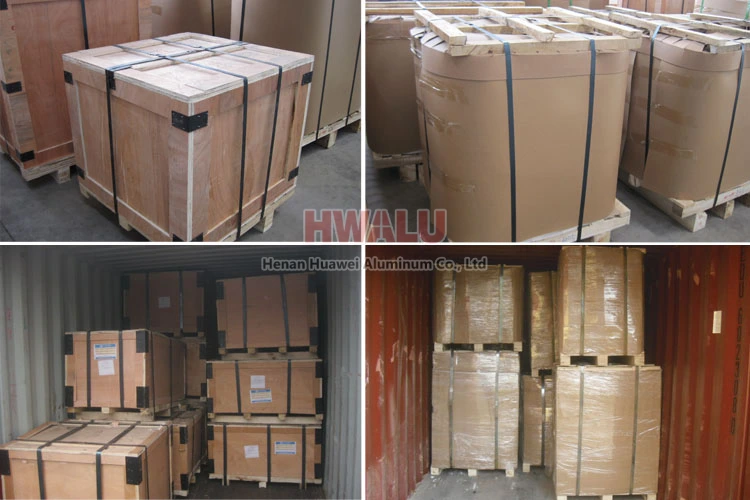
Aluminum discs packing:
Aluminum circles can be packed by export standards, covering with brown paper and plastic film. Finally, the Aluminium Round is fixed on a wooden pallet/wooden case.
- Put the driers side the aluminum circle, keep the products dry and clean.
- Use clean plastic paper, pack the aluminium circle, keep good sealing.
- Use the snakeskin paper, pack the surface of the plastic paper, keep good sealing.
- Next, there are two ways of packaging: One way is wooden pallet packaging, using the crusty paper packing the surface; Another way is wooden case packaging, using the wooden case packing the surface.
- Finally, lay the steel belt on the wooden box’s surface, keeping the wooden box fastness and secure.
Aluminum circle of Henan Huawei Aluminum. meet the export standard. Plastic film and brown paper can be covered at customers’ needs. What’s more, a wooden case or wooden pallet is adopted to protect products from damage during delivery. There are two kinds of packaging, which are eye to wall or eye to the sky. Customers can choose either of them for their convenience. Generally speaking, there are 2 tons in one package, and loading 18-22 tons in 1×20′ container, and 20-24 tons in 1×40′ container.
Why choose us?
In order to move with the times, HWALU keeps introducing the state of the art equipment and technique to improve its competitiveness. Always adhere to the business philosophy of quality as the center and customer first, to provide the highest quality aluminum disc circle series products to all parts of the world. More …

