Reflectivity, Ductility, and Forming Performance of Aluminum Discs Used in the Lighting Industry
Aluminum reflector disc for lighting has become one of the most essential raw materials in modern lamp manufacturing due to its combination of high reflectivity, excellent ductility, and predictable forming behavior. These properties determine not only the optical efficiency of the final luminaire but also the processing stability during spinning, stamping, or deep drawing. As manufacturers pursue lighter structures and higher luminous performance, the selection of aluminum discs has become increasingly technical and specification-driven.

1. Surface Reflectivity and Optical Stability
Reflectivity is the core functional characteristic for lighting applications. Aluminum discs, especially those made from 1050, 1060, and 1100 alloys, offer optical advantages due to their purity and clean metallurgical texture.
Key Factors Affecting Reflectivity
- Surface Roughness (Ra): Lower roughness increases specular reflection.
- Alloy Purity: High-purity alloys reduce micro-defects that scatter light.
- Heat Treatment State: O-state improves consistency during polishing.
- Surface Finishing: Mirror polishing, anodizing, and bright-treatment enhance optical uniformity.
- Oxide Layer Quality: A stable anodized film prevents oxidation-induced reflectivity loss.
Table 1. Typical Reflectivity Levels for Lighting-Grade Aluminum Discs
| Alloy |
Surface Condition |
Reflectivity (Specular) |
Common Lighting Applications |
| 1050 |
Polished / Anodized |
83–87% |
Indoor reflectors, downlights |
| 1060 |
Mirror Finished |
87–92% |
High-efficiency reflectors, LED modules |
| 1100 |
Bright-Treated |
80–85% |
General-purpose lampshades |
| 3003 |
Mill Finish |
75–82% |
Heat-resistant reflectors |
High-specular mirror finishes are widely used in LED high-bay lamps, commercial lighting fixtures, and architectural reflectors.
2. Ductility and Deep-Drawing Behaviour
Ductility determines whether the aluminum disc can undergo large plastic deformation without cracking. Lighting housings and reflectors often require:
- Deep drawing up to 40–60% deformation
- Multi-pass spinning at controlled speeds
- Uniform strain distribution to avoid orange-peel surfaces
Factors Enhancing Ductility
- Annealing State (O-State):
Provides low hardness and high elongation.
- Grain Size Control:
Fine and uniform grains reduce localized stress concentration.
- Purity and Alloying Elements:
Alloys such as 1050/1060 have minimal alloying additions, improving extension rates.
- Reduction Ratio in Rolling:
Influences texture formation and anisotropy.
Table 2. Mechanical Properties of Common Lighting-Grade Aluminum Discs
| Alloy |
Temper |
Tensile Strength (MPa) |
Elongation (%) |
Formability Rating |
| 1050 |
O |
60–95 |
30–40 |
Excellent |
| 1060 |
O |
65–100 |
28–38 |
Excellent |
| 1100 |
O |
70–110 |
25–35 |
Very Good |
| 3003 |
O |
95–130 |
20–30 |
Good |
These properties directly determine whether complex geometric shapes—such as parabolic reflectors or deep cylindrical housings—can be formed without cracking or wrinkling.
3. Forming Performance in Lighting Manufacturing
The forming behavior of aluminum discs is essential in industrial lighting production where components are shaped using processes such as:
- Metal spinning
- Deep drawing
- Stamping
- Hydroforming
- Pressure forming
1. Metal Spinning Performance
Aluminum discs with high ductility and uniform grain distribution exhibit:
- Smooth flow during spinning
- Minimal surface waviness
- Reduced risk of edge tearing
- Stable geometric control in parabolic and conical shapes
Lighting reflectors often require flawless surface continuity to maximize optical performance.
2. Deep Drawing and Press Forming
Performance indicators include:
- Limit Drawing Ratio (LDR) between 2.0–2.3 for pure aluminum
- Low earing tendency due to controlled rolling texture
- Stable recoverability during annealing
These qualities ensure the disc can be formed into deep or complex reflectors without defects.

3. Anodizing and Surface Treatment Compatibility
Lighting reflectors require consistent aesthetic appearance. Aluminum discs must provide:
- High-quality anodizing response
- Uniform color tone
- Resistance to thermal discoloration
- Strong adhesion of brightening layers
These attributes improve both the durability and optical stability of the lighting fixture.
4. Thermal Conductivity and Heat Management Benefits
Aside from reflectivity, aluminum discs contribute to thermal management—a crucial factor in LED lighting.
Benefits include:
- High thermal conductivity (approx. 200–235 W/m·K)
- Fast dissipation of heat from LED chips
- Reduction of thermal deformation
- Improved lifespan of LED modules
This makes aluminum preferable to stainless steel or coated iron, which offer lower thermal efficiency.

5. Applications Across the Lighting Sector
Aluminum discs are used in:
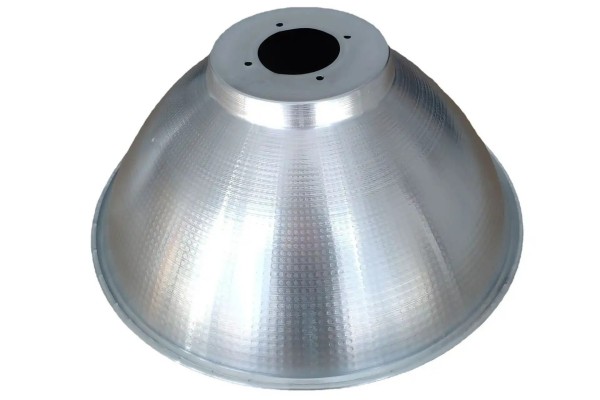
- LED reflectors
- Downlight reflectors
- Spotlights and track lighting
- High-bay industrial reflectors
- Architectural luminaires
- Outdoor lamp housings
- Parabolic and conical reflectors
Their combination of optical and mechanical performance supports both functional and decorative lighting systems.
Conclusion
Lighting-grade aluminum reflector disc for lighting materials deliver an exceptional balance of reflectivity, ductility, and forming performance. The controlled microstructure, high purity, and compatibility with advanced finishing processes make these discs indispensable in modern reflector and lamp housing manufacturing. From commercial lighting systems to high-efficiency LED reflectors, aluminum discs continue to set industry standards for optical performance and manufacturability.
Properties of the aluminum circle:
Aluminum circle is suitable for many markets, including cookware, automotive and lighting industries, etc., thanks to good product characteristics:
- Low anisotropy, which facilitates deep drawing
- Strong mechanical properties
- High and homogeneous heat diffusion
- Ability to be enameled, covered by PTFE (or others), anodized
- Good reflectivity
- High strength-to-weight ratio
- Durability and resistance to corrosion
Aluminum Circles Process
Ingot/Master Alloys — Melting Furnace – Holding Furnace — D.C. Caster — Slab —- Scalper — Hot Rolling Mill – Cold Rolling Mill – Punching – Annealing Furnace — Final Inspection – Packing — Delivery
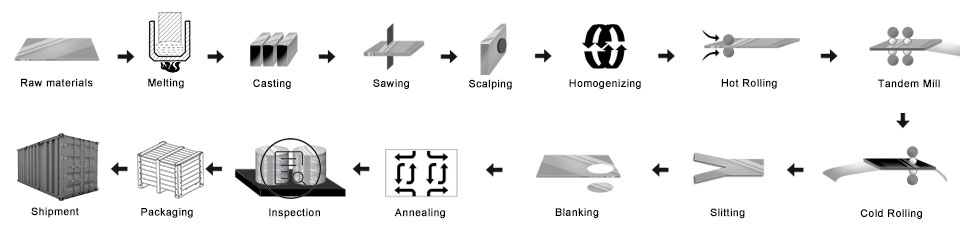
- Prepare the master alloys
- Melting furnace: put the alloys into the melting furnace
- D.C.cast aluminum ingot: To make the mother ingot
- Mill the aluminum ingot: to make the surface and side smooth
- Heating furnace
- Hot rolling mill: made the mother coil
- Colding rolling mill: the mother coil was rolled as the thickness you want to buy
- Punching process: become the size what you want
- Annealing furnace: change the temper
- Final inspection
- Packing: wooden case or wooden pallet
- Delivery
Quality Control
Assurance Below inspection will be done in the production.
- a. ray detection—RT;
- b. ultrasonic testing—UT;
- c. Magnetic Particle Testing-MT;
- d. penetration testing-PT;
- e. eddy current flaw detection-ET
1) Be free from Oil Stain, Dent, Inclusion, Scratches, Stain, Oxide Discoloration, Breaks, Corrosion, Roll Marks, Dirt Streaks, and other defects which will interfere with use.
2) Surface without black line, clean-cut, periodic stain, roller printing defects, such as other gko internal Control standards.
Aluminum discs packing:
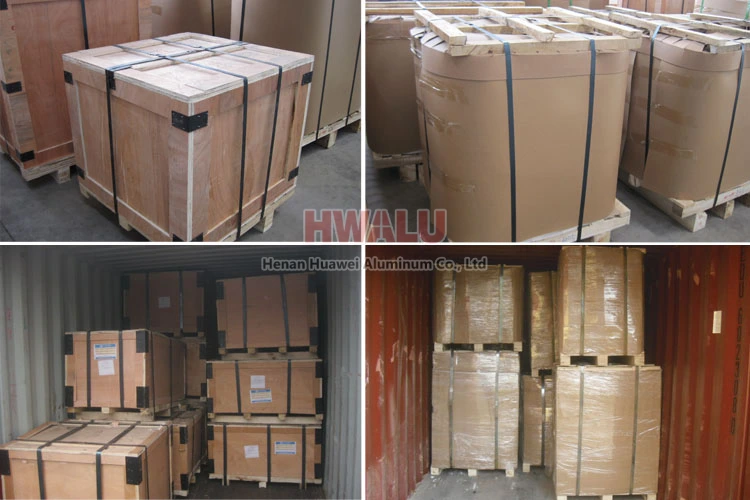
Aluminum circles can be packed by export standards, covering with brown paper and plastic film. Finally, the Aluminium Round is fixed on a wooden pallet/wooden case.
- Put the driers side the aluminum circle, keep the products dry and clean.
- Use clean plastic paper, pack the aluminium circle, keep good sealing.
- Use the snakeskin paper, pack the surface of the plastic paper, keep good sealing.
- Next, there are two ways of packaging: One way is wooden pallet packaging, using the crusty paper packing the surface; Another way is wooden case packaging, using the wooden case packing the surface.
- Finally, lay the steel belt on the wooden box’s surface, keeping the wooden box fastness and secure.
Aluminum circle of Henan Huawei Aluminum. meet the export standard. Plastic film and brown paper can be covered at customers’ needs. What’s more, a wooden case or wooden pallet is adopted to protect products from damage during delivery. There are two kinds of packaging, which are eye to wall or eye to the sky. Customers can choose either of them for their convenience. Generally speaking, there are 2 tons in one package, and loading 18-22 tons in 1×20′ container, and 20-24 tons in 1×40′ container.
Why choose us?
In order to move with the times, HWALU keeps introducing the state of the art equipment and technique to improve its competitiveness. Always adhere to the business philosophy of quality as the center and customer first, to provide the highest quality aluminum disc circle series products to all parts of the world. More …

